

DYLAN SMITH
THE campaign to see some 2,500 National Service Vietnam veterans recognised continues for Narrabri’s Richard Barry.
Mr Barry, himself a Vietnam veteran, has led a continued push to see veterans’ service acknowledged through the Republic of Vietnam Campaign Medal (RVCM).


Within that cohort, Mr Barry has also provided assistance to many Vietnam veterans (Army, Navy and Air Force) who, through no fault of their own, were sent back to Australia without being awarded the medal because they had not served the ‘required’ 181 days in the combat zone.
“These men had fulfilled their lawful conscription period and under the National Service Act 1964 (as amended) they were required for civilian reinstatement as their employer did not have to hold their jobs one day longer than the call-up period,” Mr Barry said.
“In 2022, the Australian government accepted a recommendation from the Defence Honours and Awards Appeals Tribunal to include certain psychological conditions, such as PTSD, under the wounded-in-action provisions when determining eligibility for the RVCM.
“Unfortunately, there was no public announcement or press release regarding this important change in interpretation. Naturally, there is a strict assessment protocol that applies to every application.”
Mr Barry has had some success in seeking recognition for local Vietnam veterans and their families and is still assisting some families with applications.
“The decision endorsed by the Minister for Veterans’ Affairs and Defence Personnel represented a significant breakthrough. It demonstrated that the number of days served in Vietnam is not the sole determinant of eligibility for the RVCM,” Mr Barry said.
“I also have a list of 11 young Australians who lost their lives within 30 days of arrival, together with a further five who died within 60 days of arriving in-country. All were awarded the RVCM posthumously.
“Their cases further illustrate that service duration has never been the only criterion applied when determining eligibility.
“There is still much voluntary work to be done. At present, the Directorate of Honours and Awards is dealing with a very large number of applications across a broad range of honours and awards, and the current processing time is approximately six months.”
The campaign for recognition has been a long one for Mr Barry, who successfully brought the matter to the attention of RSL NSW.
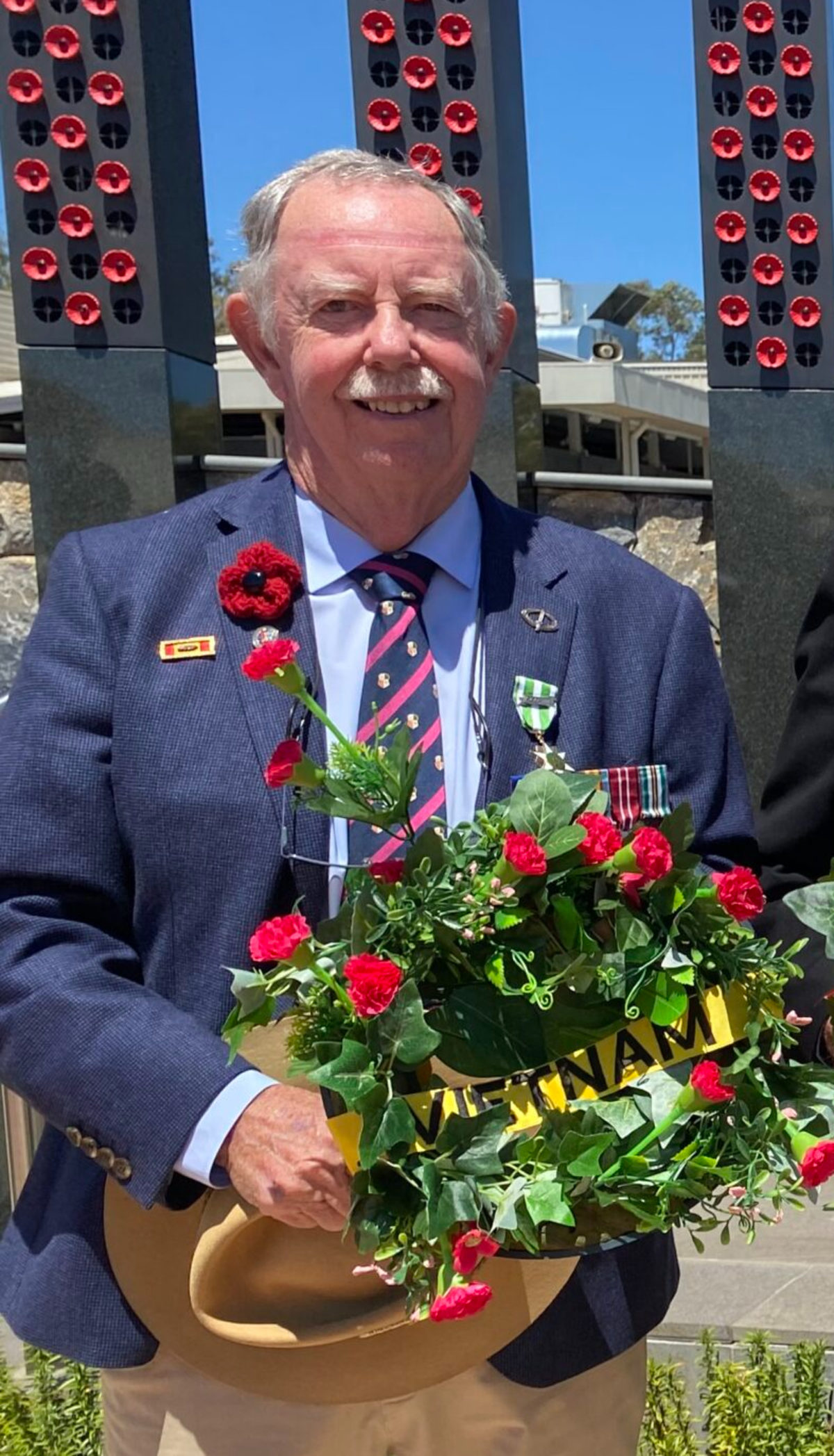
Narrabri Vietnam veteran Richard Barry continues his push for recognition of Vietnam War Nashos.
Subsequently, the RSL put together its own detailed submission paper and brought the matter to the attention of the Prime Minister.
Writing to Anthony Albanese, the NSW RSL said Mr Barry, a former national serviceman from the 10th intake who served in Vietnam in the 6th Battalion RAR, “has led a dogged, decades-long fight to ensure his comrades, who had served at least 60 days but fewer than 181 days in Vietnam when they were returned to Australia at the end of their period of conscripted or enlisted service, are appropriately recognised”.
“Mr Barry’s campaign for this 2,500-strong ‘Nasho’ cohort to be deemed eligible for the RVCM has enduring support from a former Governor-General, four former Prime Ministers, past and present parliamentarians on both sides of politics, retired senior military officers from Australia and Vietnam, ex-service and veterans’ support organisations, as well as Australia’s Vietnamese community,” the letter reads.
“Conscripted from cities and towns across Australia, these brave men were forced to leave their loved ones and their civilian employment to fight a war on foreign soil to defend our nation’s interests.
“It’s undeniable that they faced the same harrowing conditions as their mates who served in Vietnam for the required 181 days.”
In its letter to the Prime Minister, the NSW RSL said it was not seeking a change to the eligibility requirements, however, was seeking equitable consideration and empathetic interpretation of the criteria – “noting that other empathetic interpretations have been made by government in relation to the RVCM in the past”.
“The granting of the RVCM to those veterans who suffered psychological injury because of their service as combatants in Vietnam is one recent example of an equitable and empathetic interpretation by government of the criteria, with those veterans now recognised by the DHAAT as ‘wounded in action’,” the letter reads.
To order photos from this page click here