


Below is the oration, read by Narrabri RSL sub-branch president and Vietnam veteran Gary Mason OAM at last Thursday’s Victory in the Pacific/Vietnam veterans commemoration.
By Gary Mason OAM
Following the Japanese attack on Pearl Harbour on December 7, 1941, the Japanese southern advance was swift and effective, landing in the Philippines on December 10 and reaching New Guinea by March 1942.
The war was on our door step and Australia contemplated possible Japanese invasion and plans were initiated to abandon most of the continent north of the famous Brisbane line between the cities of Brisbane and Adelaide.
In response to the Japanese rapid advancement, Australia had already mobilised seven militia divisions early in January 1942, and redeployed the 1st Australian Corps from the Middle East to the Far East. At about the same time the Port Moresby garrison was strengthened by two militia battalions.
Fortunately on May 8, 1942 the US Navy, supported by ships of the RAN, turned back a Japanese convoy headed for Port Moresby at the Battle of the Coral Sea. After a further naval defeat at Midway on June 6, the Japanese attempted a northern overland attack against Port Moresby.
It has to be stressed that the Japanese losses at the battles of the Coral Sea and Midway had forced them to change their plan on the invasion of New Guinea, changing from a naval assault on Port Moresby to an overland attack from the northern coast.
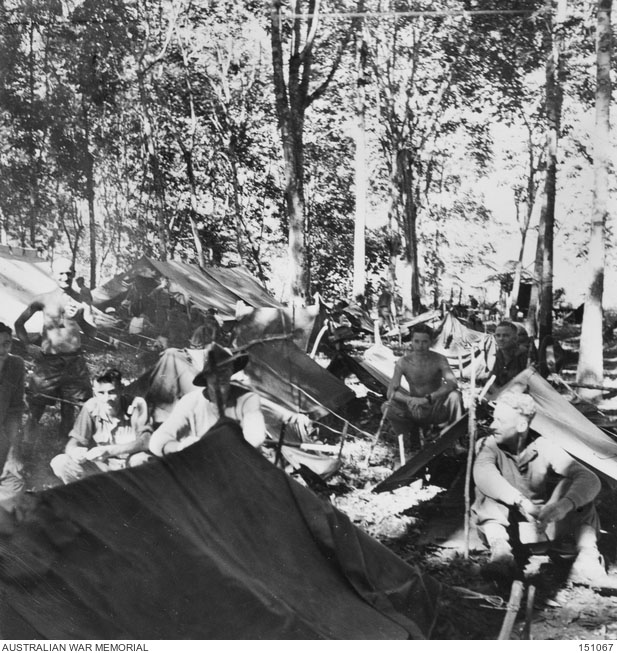
The Japanese continued their campaign to seize New Guinea and on July 21-22, 1942 landed two infantry regiments with supporting troops at Gona and quickly moved inland to the northern start of the Kokoda Track.
They planned to advance across this tortuous path and take Port Moresby from the north. The small Australian forces in the Buna/Gona area, and later the 39th Battalion coming up the track to reinforce Kokoda, fought a desperate rearguard action but were pushed all the way across the Owen Stanley Ranges. On August 23, the 21st Brigade of the 7th division was sent into action on the track. Fierce fighting continued but after a desperate struggle the Australians withdrew closer to Port Moresby.
Meanwhile Milne Bay had been reinforced by Army and RAAF units, which pre-empted the Japanese attempt to capture Milne Bay as an additional base from which to advance on Port Moresby.
The Australian Army and Air Force worked together to defeat the Japanese. Two weeks after landing, the Japanese withdrew. To the Australian Diggers and Airmen’s credit this was the first time in the Pacific War that a Japanese land force had been forced to retreat.
British Field-Marshal Sir William Slim, the brilliant commander of the XIV Army in Burma, later commented that: “Australian troops had, at Milne Bay, inflicted on the Japanese their first undoubted defeat on land. Some of us may forget that, of all the allies, it was the Australians who first broke the invincibility of the Japanese army.”
By November 2 the reinforced Australians had retaken Kokoda and on November 11 Japanese fighting units were forced to abandon Oivi. By November 13 the Australians had reached the Kumusi River. Although Japanese units continued to resist until mid-January 1943, the battle for the Kokoda Track was over. This victory is richly remembered and woven into the fabric of our nation’s history.
World War II was Australia’s first and only taste of global war that reached our shores.
Men and women were called upon to serve in the armed forces or merchant navy or in essential industries. Nearly one million served in uniform – most in the Pacific or on the home front. The war cost 40,000 Australian lives.
Of these, 19,000 servicemen and women, more than 600 merchant seamen and several hundred civilians lost their lives in the Pacific and south-east Asian theatres, It would be remiss of me not to mention the Australians and other prisoners of war who endured brutal slave labour, disease, starvation, beatings and executions. They were sent all over the Japanese ‘empire’, from the Burma-Thailand Railway to the infamous Sandakan prison camp in Borneo to coalmines in Japan. Over 8000 Australians died in captivity.
We must never forget the sacrifices made by Australian men and women while defending our shores in those trying times of the Pacific War.
We will forever be indebted to the brave souls who turned back the advancing Japanese forces in the New Guinea conflict and more importantly the 2134 Australians who paid the supreme sacrifice on the Kokoda Track and at Milne Bay.
We also pay tribute to all current and former members of the Australian Defence Force, including those lost in training, on operations, the wounded, the injured and the ill. Lest We Forget.
To order photos from this page click here