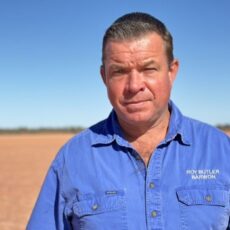



When heritage rail enthusiasts talk about the romance of the steam train era and ‘the magic of steam’, Narrabri’s George Sanderson knows exactly what they mean.
George was a steam locomotive fireman and driver in the 1960s and has fond recollections of those days, more than 50 years later.
“Wonderful memories,” he said.


George was recalling his days in the locomotive cabin as a fireman and driver after he, along with many hundreds of others, went down to Narrabri railway station on the long weekend to inspect the visiting steam loco and take a nostalgic ride aboard steam-era passenger carriages.
It was all very familiar to George.
“I started as a fireman on coal fired steam trains in 1961,” he said.
He traversed thousands of miles of Sydney, North Western NSW, New England, the Hunter and North and Central Coast railways until 1966 when he was conscripted for National Service in the Vietnam War.
“I worked on a lot of passenger trains around Newcastle and Gosford, Maitland. I was based in Broadmeadow, but we’d get a job to Sydney or Enfield and stay in barracks overnight and then get a job back.
“A lot of the people I talk to around Narrabri tell me the number of trips they made on the North West Mail and I’m thinking I was probably the person up there firing the engine on those trips.”
George saw action in Vietnam, notably in the heavy battles fought by the Australians at fire support bases Coral and Balmoral against the North Vietnamese Army in Bin Duong and Bien Hoa provinces, South Vietnam, May 12 to June 6, 1968, for which he shared in a Unit Citation for Gallantry.
After demobilisation and his return to civilian life he rejoined NSW Railways but learned he had to undergo re-training as the locos were entering the diesel era.
However, for George, nothing was as good as steam locomotion.
“I just loved it,” he said.
Being a fireman meant shovelling coal into the engine’s firebox, more or less continuously throughout the journey.
“It could be freezing outside in winter but we didn’t know, or hot in summer, but we didn’t mind that either and really didn’t notice,” he said.
Coal arrived at the back of the cabin by chute, but keeping the fuel up to the firebox meant sometimes having to go to the back of the coal tender and shovel the coal forward – “it’s quite a long trip.”
“We definitely shovelled a lot of coal on a long trip – some coal was better than others and burned a lot better.
“It was all about keeping the balance of fire and water right. Locos filled up with water at pumps in centres like Singleton, Muswellbrook and Werris Creek on their way through the North West. I was a Mail fireman so I fired all sorts of engines. The North West Mail, we used to call number 13, I fired that quite a few times.
“We had a 36 class engine, and quite often a bigger 38 class up to Broadmeadow, but they were too heavy to come up this line.”
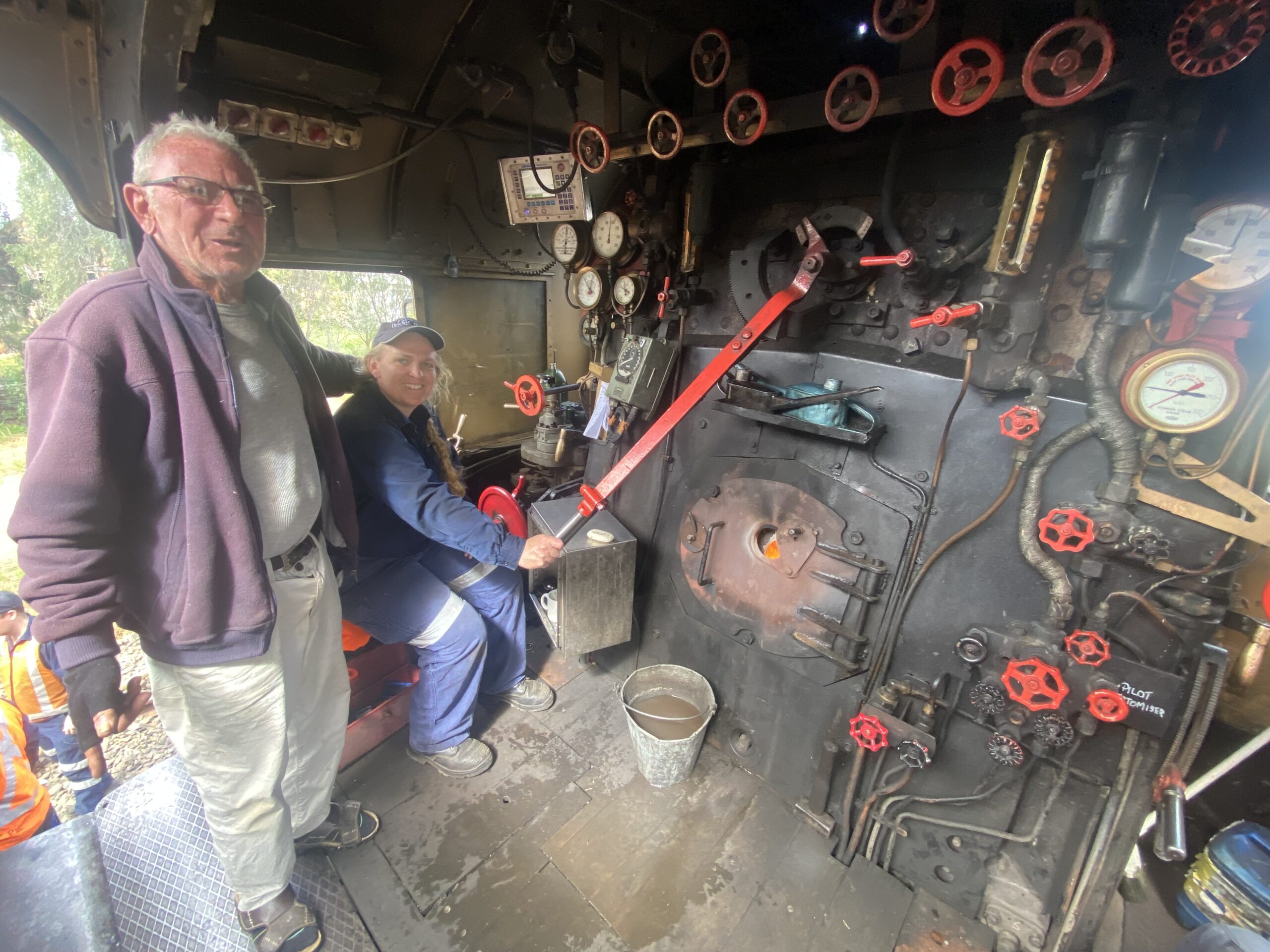
It was a blast from the past when George climbed aboard the R776 engine at Narrabri. “It’s a bit of a cross between a 36 and 38 class.
“I was surprised when I got up into the engine I thought ‘where’s the coal tender?’ – but of course it was an oil burner.”
The firebox naturally threw a lot of heat back.
“But the cabin temperature never really affected me,” said George.
“I often get comments on that. You probably just adjust your body temperature. It was all great.
“When I got back from Vietnam I had to qualify to be a Mail fireman again. When you are qualified to drive Mail trains, you can operate all the important trains.
“It meant I could fire all those trains, but because of my two years’ National Service I had to go back to school and learn to be a driver – but you find out at four in the afternoon what you are going to be doing from midnight onwards.
“I went back and qualified as a fireman and transferred from steam to what was mostly diesel, and that was boring. You just sat there pressing the vigilance button which is there to keep the drivers awake.
“A lot of the times you were not only the fireman but also a driver. I used to work with a regular driver, the same one all the time, and often I would be the fireman for half the trip and he would be the fireman and we would switch over.
“Great memories. I loved the steam engines, there is a special challenge about them, making them do what you want them to do.
“Road knowledge was an important part of driving, you know where all the crossings are and you have to let people know that you are coming to the crossing so you are always sounding the whistle, when to shut the engine off, when to open the throttle. There were no gears as such on those locos but we had something like a big steering wheel for the driver, the further forward the driver wound it the lower the pressure or the steam and the more powerful the engine.
“You wind the other way back to neutral and then you can come back further and go into reverse, so you can use that as a brake. You start off wound right forward, start off slow, and slowly wind it back until you get to whatever speed you want to do.
“The loco in Narrabri on the long weekend was a bit of a cross between a 36 and a 38 class, the 38 had sightly bigger drive wheels than a 36 but they couldn’t bring a 38 up here because they are too heavy.
“A 38 class loco was used on the Newcastle Flyer from Sydney to Newcastle. We would stop at Fassifern and from there to Broadmeadow Station would take 19 minutes. When they replaced the 38 steam locos with diesels they could never equal that time. The steam locos were that much quicker. From Fassifern you have a bit of an upgrade and so the 38 class locos actually picked up momentum before they went up the hill and then down to Broadmeadow – it was quicker than a diesel could ever be. I’m not sure what the top speed of an engine like a 38 class would be, but it was quick.
George recalls his days of steam with affection.
“Beautiful memories. Good old memories,” he says.
To order photos from this page click here