


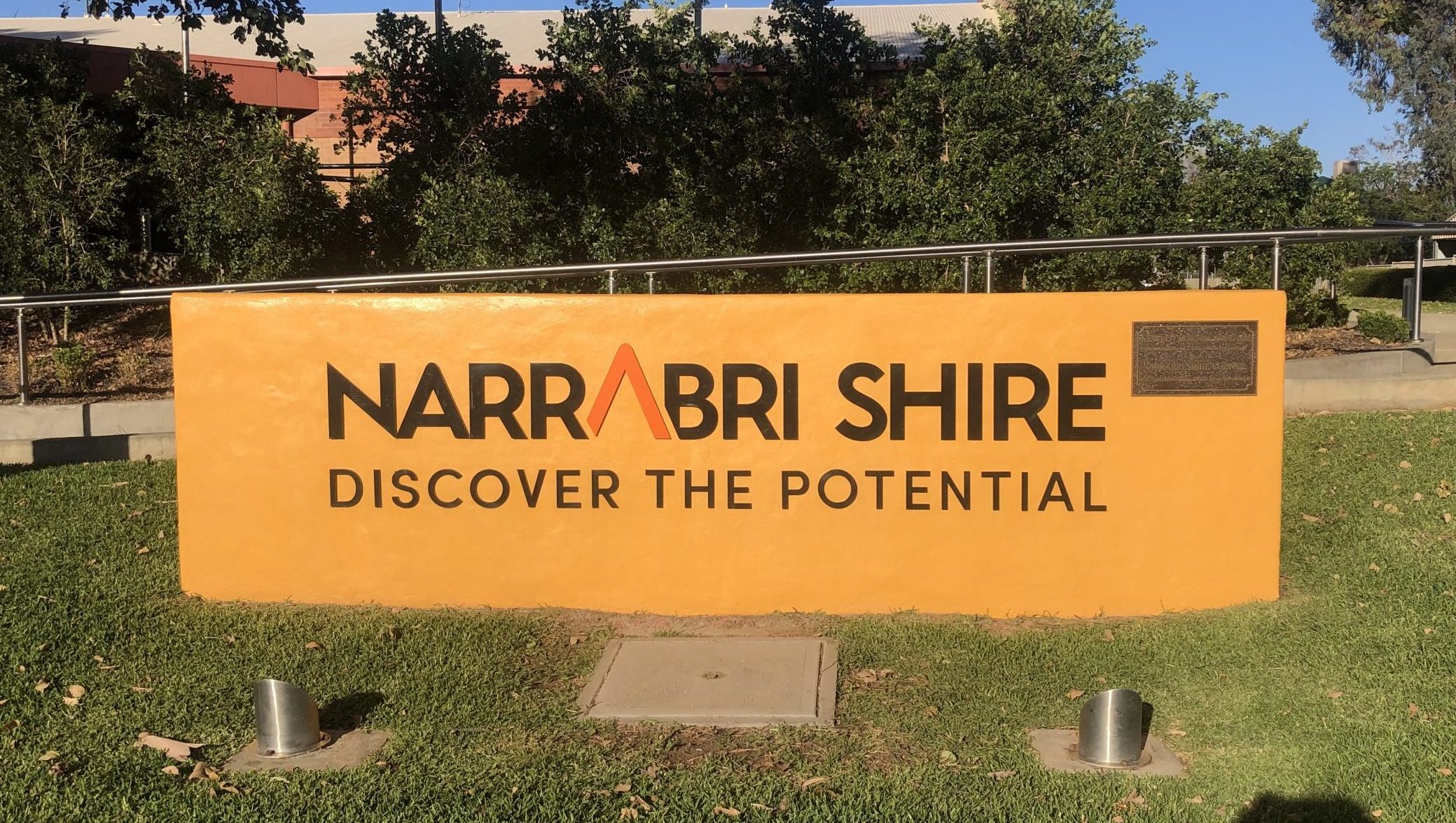
The formation of the next Narrabri Shire Council remains unclear, with counting underway to determine who will become the shire’s next nine councillors.
Counting started following the closing of the polls on Saturday evening and has continued from Monday onwards.
While the exact make-up of the next council is still unknown, it will likely consist of up to seven or eight new councillors.


Of the formal votes counted as at Wednesday afternoon, Group F (Brett Nolan) had received the most above-the-line first preference votes so far, with 878 votes (18.5 per cent).
Group D (Ethan Towns) had received 817 votes (17.2 per cent). The group received a significant boost earlier in the week when pre-poll votes at Wee Waa were included in the results.
Group B (Darrell Tiemens) had received 719 votes (15.15 per cent).
While the exact results of each group are unclear, each of those groups will likely have at least one representative on council.
Group A (Joshua Roberts-Garnsey) had received 439 votes, or 9.25 per cent, Group C (Greg Lamont) had received 382 votes, or 8.05 per cent, and Group E (Ian Passmore) had received 158 votes, or 3.33 per cent.
Narrabri GP Dr Navin Erathnage had received the most votes of individual candidates with 328 votes (6.91 per cent).
Results from Boggabri favoured local candidate Peter Guest who totalled 323 votes (6.81 per cent).
Other candidates’ results include Brett Dickinson 195 (4.11 per cent), Ken Flower 159 (3.35 per cent), Cathy Redding 144 (3.03 per cent), Colin Armstrong 135 (2.85 per cent), Glen Stoltenberg 58 (1.22 per cent) and Matthew Bullock 10 (0.21 per cent).
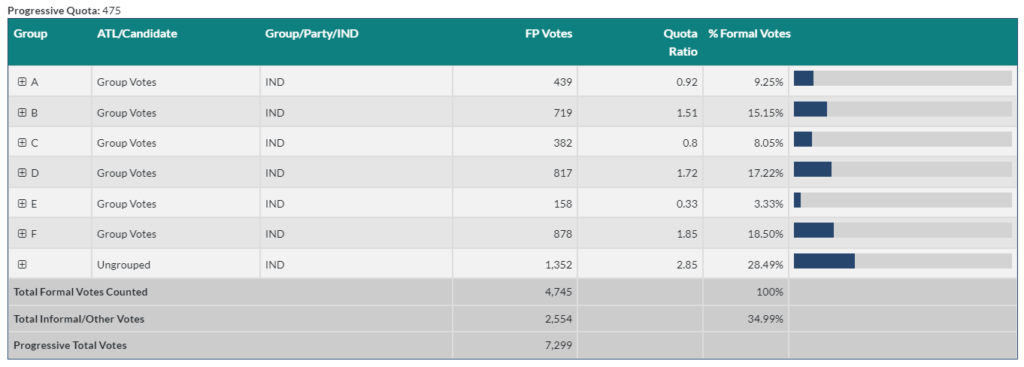
Election results as at 6.17pm on Wednesday, September 18.
There was initial confusion as more than 2500 votes had been categorised as informal/other. However, below the line votes cast for groups form part of this category and will be checked.
“At this early stage of the count process, the ‘informal/other’ category does not just include informal votes. It also includes other types of votes that undergo further sorting and counting,” said Dr Phillips.
“For example, some candidates’ formal, below the line votes are included in the ‘informal/other’ category votes figure category. In the virtual tally room these candidates are marked with an asterix.
“During the check count, these votes will be reviewed and, if formal, moved out of the ‘informal/other’ group and included in the formal count numbers.”
Dr Phillips said the ‘informal/other’ category also includes ballot papers that are unclear ballot papers, and formal ballot papers that are marked both above and below the line.
In the check count, all ballot papers will be data entered into our computer count system where each ballot paper is re-checked for formality and sorted to their correct category.
After the check count, the ‘informal/other’ votes number will reduce as the votes initially allocated to this category undergo scrutiny by election officials.
Counting is proceeding in line with legislative requirements and the published count timeline.
All count results (initial counts, check counts, and distribution of preferences) will be published as soon as they are available.
The count cannot be concluded until all postal votes have been returned to the Electoral Commissioner. The deadline for return of completed postal votes is 6pm on Friday,
September 27.
The distribution of preferences to determine the elected candidates can only be conducted after the close of receipt of postal votes and after all check counts are complete. It is performed using the NSW Electoral Commission’s computer count system.
When all the votes have been counted, the official announcement of the elections result will be declared in writing. Results will be declared between and October 1 and 3.
To order photos from this page click here