


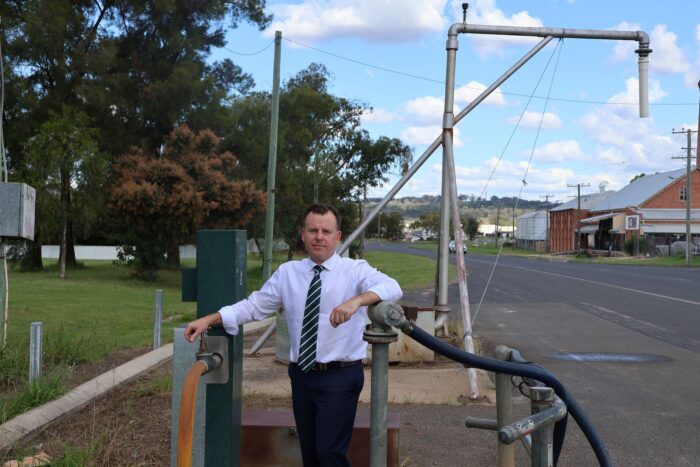
Member for Northern Tablelands Brendan Moylan has warned the proposed unaffordable increases to rural water prices should concern everyone in the Northern Tablelands.
If implemented, the proposed increases will see a rise in costs of over 200 per cent in the next five years.
Water NSW and the Water Administration Ministerial Corporation recently submitted a pricing proposal to IPART which will affect all water-using regional businesses including farmers, graziers, manufacturers, Councils, and food processors.


In August this year, NSW Premier Chris Minns wrote to IPART on behalf of Sydney residents amid concerns of the rising cost of the capital’s water prices.
Mr Moylan is urging Mr Minns to do the same to look after rural communities.
“If it is good enough for Sydney water users to have their cost-of-living pressures taken into account by the Premier, then regional and rural water users should also be shown the same level of support,” he said.
“The proposed price increases will greatly affect farmers, irrigators, graziers, councils, and all bulk water users which in turn will affect the rest of the community.
Mr Moylan filed a Notice of Motion in Parliament during the November sittings which called on the state Labor government to urgently intervene to ensure water prices remain fair and equitable for everyone in regional NSW.
“The proposed price increases are simply unaffordable for regional businesses and councils,” he said.
The state’s peak irrigators’ body, the NSW Irrigators’ Council, is also alarmed by the proposal and has urged stakeholders across industries to understand the implications by the new pricing structure.
The council’s chief executive officer Claire Miller said the pricing proposal recommends hiking water bills by 21-24 per cent every year for five years, adding up to $40,000 to a ‘typical’ farmer’s water bill by 2030.
“Many stakeholders are not fully informed about the proposed prices, leaving them at risk of being unprepared until it is too late,” Ms Miller said.
“This translates to the typical farmer with a high security entitlement paying $7924 more each year and the typical general security entitlement holder paying $3840 more each year.
“But WaterNSW’s typical farmer scenario masks IPART’s valley by valley pricing scenarios, in which different valleys are facing cumulative price increases of 200 per cent and more over five years. These pricing increases are simply unaffordable – they will send family farms and other rural industries using water out of business.
“The water pricing model in NSW is fundamentally broken when Rural WaterNSW customers are currently covering 80-100 per cent of both operating and capital expenses.
“Many of these costs are for public good services and activities on behalf of the broader community, such as environmental planning and protection, recreation, cultural and managed environmental flows, and the construction of fishways.
“It should not fall upon rural water customers to pay for these additional public good services.
“Rural water customers should be charged only to the extent of what it costs to deliver water, and that all other costs associated with water management should be shared across the community via the public purse.
“WaterNSW’s revenue requirements are rising faster than businesses’ capacity to pay. Rural water customers are already grappling with soaring input costs — interest rates, fuel, insurance, machinery, wages, and energy.
“This is not just about farmers; everyone will feel the pinch from racing, to manufacturing, mining, processing and competitive sports like golf.”
Landholders using irrigation are also facing higher water allocation prices due to state and Commonwealth environmental water recovery.
Few rural water customers can absorb these exorbitant increases in their water costs without severe financial distress.
“Price increases of this magnitude threaten the viability of small and medium family farms, leading to closures of businesses, lost employment, and a decline of industries critical to the economic and social wellbeing of regional communities,” Ms Miller said.
“If such drastic changes were proposed in any other sector, they would be met with widespread opposition. We cannot accept this unreasonable price rise and must make our position clear.”
In a statement released the day the pricing proposal was published, Water NSW said it has considered all options in keeping costs as low as possible.
“During its largest and most far-ranging engagement and consultation process to date, WaterNSW spent almost two years listening and seeking input from customers, peak industry bodies and the community, focusing on highly valued services and reducing costs for the 2025-2030 proposal,” the statement read.
“IPART, as the independent pricing regulator, will closely review the WaterNSW pricing proposal to determine whether it provides value for money, is in the long-term interests of customers, and delivers the outcomes customers need and want.”
A draft decision is expected to be published in March 2025, with a final decision due in June 2025.
To order photos from this page click here