


As shires throughout the North West recover from another major flood this month, Narrabri and Gunnedah Shire Councils are among councils still waiting for approval to undertake road repairs from floods that occurred more than three years ago.
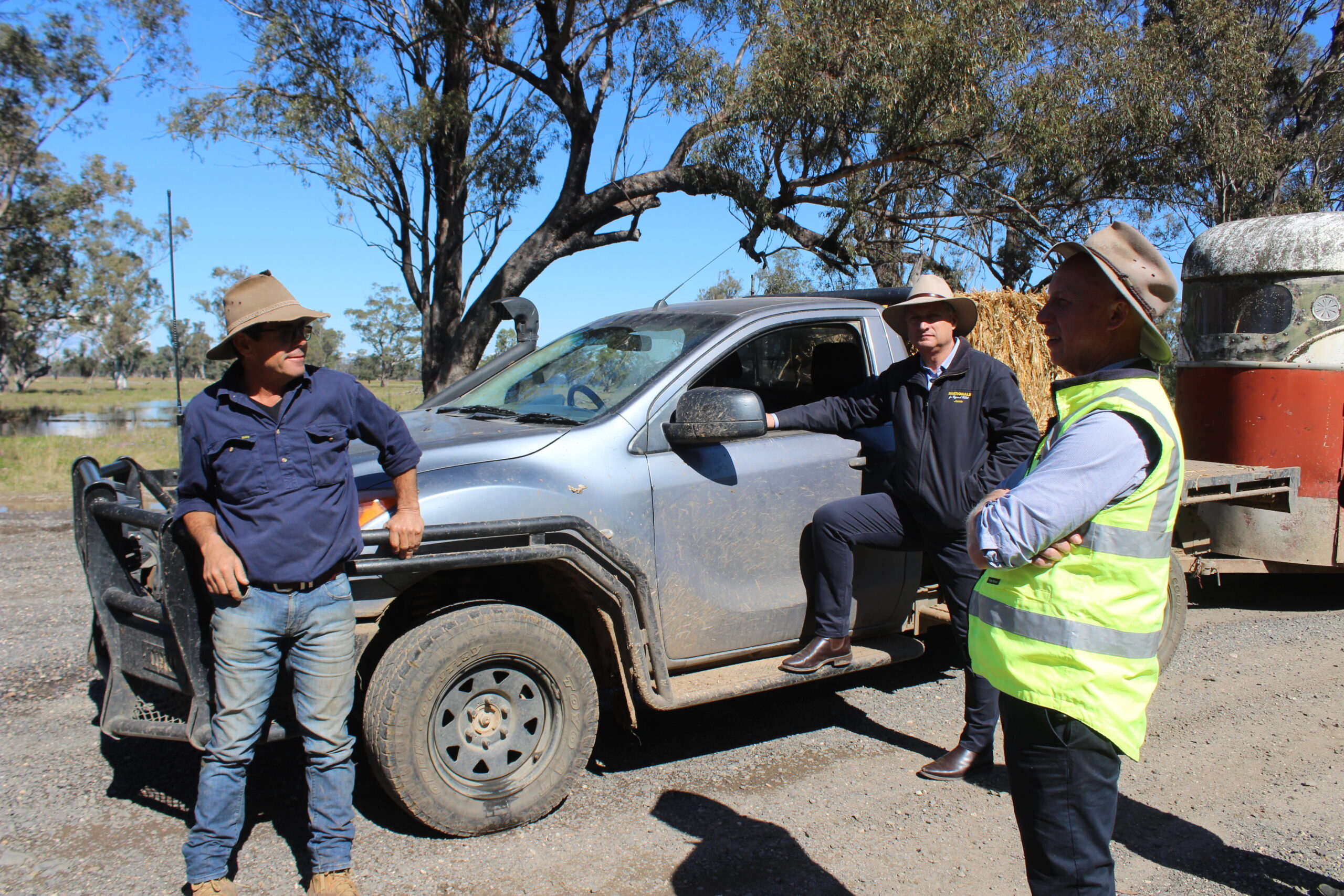
Federal Member for Parkes Jamie Chaffey inspected road damage at Grain Valley Road in Gunnedah Shire and Rangari Road in Narrabri Shire on Tuesday.
Natural disaster declarations were made for both shires on Friday after they were inundated by floodwater early this month. The flood event has caused more damage to roads already impacted by seven major flood events between November 2021 and October 2022.


Mr Chaffey said he had heard repeated accounts of huge delays in road funding approvals, with more than $4 million in repairs still awaiting funding approval in Gunnedah Shire following floods in 2022.
“The NSW government has left councils with nowhere to turn for funding certainty,” he said. “Councils have sought and been given advice, have acted on this advice and then found out that it was incorrect. This costs them money and leads to massive delays in repairing roads.
“Then, after waiting two years for funding approval in some cases, they are given a revised funding figure by the NSW government. They get the work done, only to have yet another review that again revises the funding downwards. The job has been done, the money has been spent, and the council and the ratepayer must now foot the bill, despite every effort of the council to do the right thing. It is yet another example of cost-shifting to local government.
“Added to this is the NSW government’s policy of funding only like-for-like repairs to roads. This means roads can only be repaired to the standard they were before flooding. It doesn’t provide for flood-proofing and it means that every flood is groundhog day for councils and community. The same roads again need the same repairs.
“No wonder councils absolutely despair when they are faced with another natural disaster. They have lost trust in the advice they are given and are facing reviews that come back with less and less funding to get the job done.
“I am advised there is significant federal funding available for natural disaster recovery, but it appears the New South Wales government is the blockage. It must be incredibly disappointing for councils trying to get their shires back to business following a natural disaster.”
Narrabri Shire deputy mayor Brett Dickinson said like-for-like replacement was not the answer.
“Here at Narrabri Shire Council, we are strong believers in ‘building back better’, but that is only possible with timely and well-targeted support,” Cr Dickinson said.
“Betterment is talked about at all levels of government, and with good reason; it is about making smart, lasting repairs that prevent the same flood damage from happening time and time again. By investing in stronger, more resilient roads now, we can stop waste, save taxpayer dollars, and deliver a better future for our community. Rangari Road is just one example of a high-traffic route that would benefit from this approach.
“With a road network of more than 2,000km, ratepayer contributions can only go so far, particularly after the number of flood events we have faced in recent years. We welcome any refinement to the Disaster Recovery Funding Arrangements guidelines, and we look forward to continuing our positive working relationship with Transport for NSW and, from October, the NSW Reconstruction Authority in delivering betterment outcomes for our region.”
Gunnedah Shire mayor Colleen Fuller said council felt like there were barriers at every level to securing the promised funds.
“Frustratingly for council and incredulously for the community, we are still awaiting approval to undertake almost half of the TULG (Total Upper Limit Grant) works of $10.1 million,” Cr Fuller said.
“We have had significant delays in being able to undertake repair works, receiving payment for the work that has been completed and in receiving reliable and consistent guidance on claims. We have had to look at engaging contractors to complete work after the NSW government challenged council’s estimates to do the work itself. All of this costs more money.
“As an example, Grain Valley Road was recently federally funded to be upgraded to a sealed road. Council has repeatedly been hit with the costs of repairing this road and is now being told to apply a road treatment that will limit the life of the road.”
Mr Chaffey said he will continue to seek the support of the federal Minister for Emergency Management to ensure councils get the funding they need to complete road repair works in an appropriate manner, and the cost does not fall to the ratepayers.
“Councils deserve a helping hand, not a roadblock at every turn,” he said.
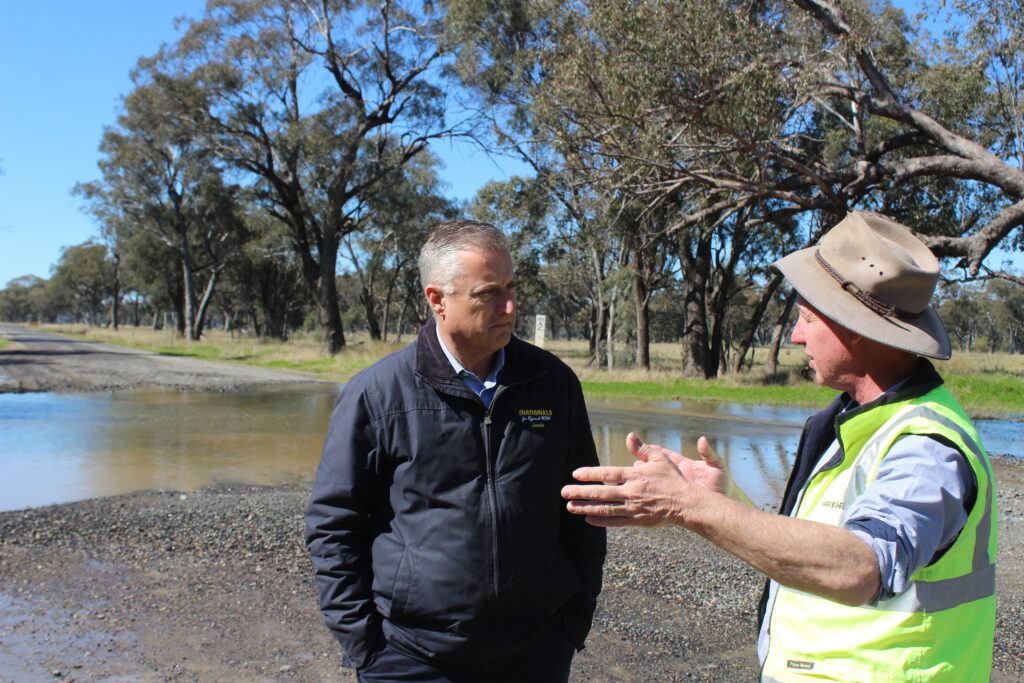
Member for Parkes Jamie Chaffey talks to Narrabri Shire Council director infrastructure Evan Harris at Rangari Road.
The Courier correspondent was witness to the state of the roads being inspected and spoke to residents who are frustrated with the state of the roads.
The roads are both still officially closed due to being covered by water and the fact that council workers cannot assess the road surface and damage while water is covering the road.
Trucks and cars were driving through causing more damage while we were standing on the side of the road, some went through the middle, others off the main track and around the outside of the flood level indicators on the sides of the road, cutting that up as well.
One lady who lives out along Rangari Road asked, “Why is the road still closed? We must be able to get to Boggabri for business and groceries without going through Gunnedah or Manilla” she said.
“The water will be over the road for weeks we all know that it happens every time we get rain, doesn’t have to be a flood. If it looks like rain we have to high tail it home so we don’t get stranded in town.”
A local farmer Richard Gillham came along with his four dogs and hay for his cattle. Fences are down, so the stock are in a safe paddock still surrounded by water on the other side of the causeway on Rangari Road and they need to be hand fed.
Mr Gillham said, “What they have been doing is not appropriate, as you have the same problem every time it rains.
“See that over there, gravel washed off the crossing, year after year, each time it’s washed off and another lot is put on, sometimes before the next flood, sometimes not, it’s a never-ending cycle, you need to invest in a better quality road to stop the waste of dollars and make a safer crossing.”
Mr Gillham shared his numerous experiences of flood rescues, a blown tyre on his tractor from road damage under the water while saving a fellow’s life in last year’s flood.
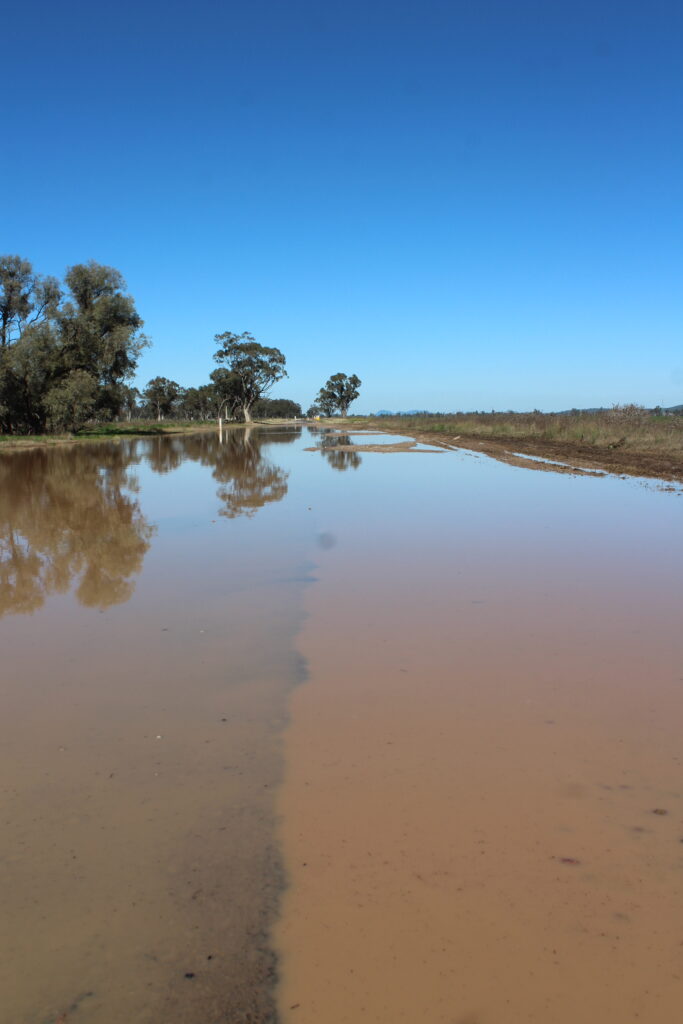
Grain Valley Road.