



Health officials have sought to allay community fears about the future of Wee Waa Hospital.
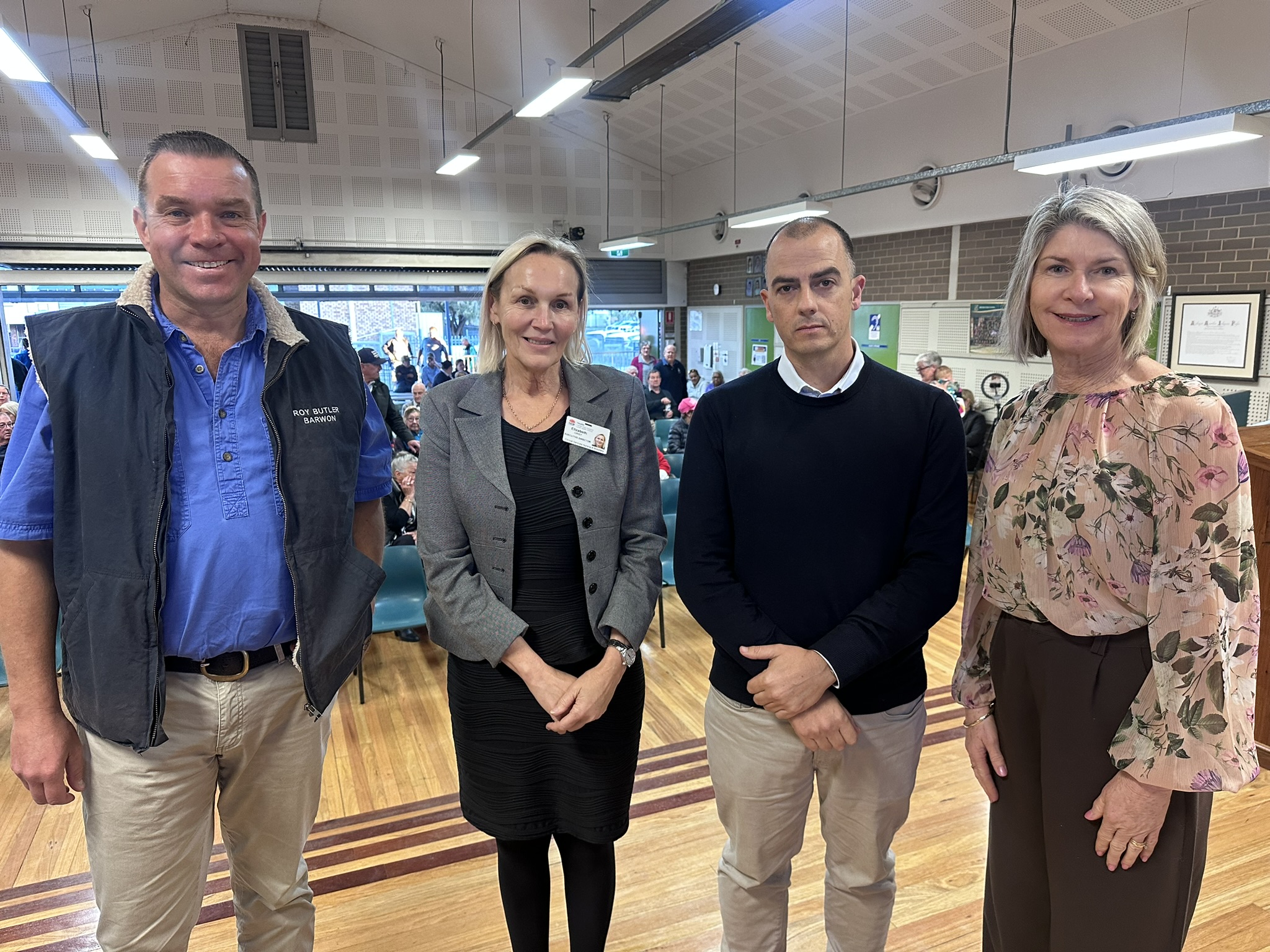
At a meeting held at the Wee Waa Public School hall, organised by Member for Barwon Roy Butler and his team, the community heard firsthand from Hunter New England Local Health District and NSW Health in relation to an independent review and recommendations made about the hospital.
Health district chief executive Tracey McCosker told the gathering “a 24/7 service with a doctor on site is our goal”.


“But the reality is quite complicated and the changes will take some time,” Ms McCosker said. “Right now, there’s a national shortage of health workers. And not just in Wee Waa, but across the state and across the country.
Ms McCosker tried to quell concerns that Wee Waa Hospital would not provide emergency care under a new operating model.
“Our priority is building a health service here in Wee Waa that can provide emergency care around the clock,” she said.
“As well, we’re planning for a small number of inpatient beds at least in the first instance, including palliative care.
“And stronger links with Narrabri.
“The goal is simple. You should feel confident coming to Wee Waa to get the care that you need regardless of where you live and whether that’s on site or whether that needs to be stabilised at Wee Waa Hospital and move on to some higher level of service.”
Ms McCosker encouraged people to continue calling 000 in emergencies.
“Don’t try to decide yourself where to go because the paramedics will assess your situation and take you to the right hospital, whether that’s Wee Waa, Narrabri, or Moree, where you’ll be assessed and depending on the severity of your clinical condition, you may then be transferred to Tamworth, Newcastle, or even Sydney. But that’s the strength of being part of a broader health network.”
The visiting officials would later be pressed about emergency situations, including local ambulance services being stretched and deployed to other locations across the region causing delays in response times.
Ms McCosker explained the staffing requirements, saying that Wee Waa requires two full-time registered nurses and two full-time enrolled nurses to support a workable roster.
“And that just covers a 10-hour shift seven days a week,” she said.
“At the moment, with our permanent staff, we fall short. So we’re relying on temporary staff to fill those gaps.
“The good news is our recent recruitment campaign has brought some interest. What matters now is making sure we have the right skill mix, nurses who are appropriately trained and qualified in areas like advanced life support and triage.
“We’ve got five candidates progressing well, and we’re hopeful they’ll be on board in the next couple of months. We’re also actively looking at all the options for medical coverage as well as incorporating roles like nurse practitioners who can diagnose, treat, and prescribe.”
“And at the same time, we’re strengthening links with Narrabri so staff can rotate between the sites and keep their skills sharp.”
NSW Health deputy secretary Luke Sloane told the gathering inside the public school hall that the building infrastructure at the hospital is “very good”.
“That’s without a doubt. When we came back and I brought the minister back with me, and I said to him as well, ‘the building infrastructure is actually quite good’. It’s very rare we get a co-located aged care facility,” Mr Sloane said.
“It’s very rare that we have onsite accommodation for some of our staff. The thing that sort of was a bit gobsmacking for me was the inability for the district to get staff to come and work here.
“The report quite clearly says, for anyone who’s read it in depth, and I’m sure you all have, that we are not closing Wee Waa Hospital.
“The report quite clearly said that we are making sure that we commit to emergency and urgent care services in that hospital. And I know some people have been getting a bit nervous about the fact that the urgent care services is being put in there. The naming or the nomenclature of that has stuck with health for many, many years, from the change of the word casualty, from casualty to emergency, from emergency to urgent care.
“We’re not talking about a Commonwealth or state-funded urgent care clinics.
“What we are saying is that when someone presents to the hospital, no matter how serious they are, they will get the urgent or emergency care that they need.
“Now, to back that up, we’ve also said that we need 24-hour beds there opening for people to be able to stay overnight or for whatever length of stay they need to happen.”
Following Mr Sloane and Ms McCosker addressing the meeting, concerned residents sought responses to issues including local VMO rights and negotiations, specifics relating to the hospital as well as previous incidents and delays in treatment resulting in distress for local families.
Locals pressed the visiting officials about the timeframe of implementing recommendations.
Ms McCosker said one of the first things to happen would be the first LHAC meeting.
Dennis Lowder queried the recommendation relating to engaging the Save Our Wee Waa Hospital group.
“We have not been engaged at all so far,” Mr Lowder told the meeting.
Ms McCosker said the group would have representation as part of the new LHAC.
Ian Taylor, chief executive officer of CSD, one of Wee Waa’s largest employers, said a challenge of the model being proposed is that it centres around Narrabri.
Mr Taylor sought clarification if Narrabri also faced challenges in recruitment and what would happen if the issue of staffing becomes far greater than Wee Waa Hospital.
“The reality is we’ve got to be agile,” he said.
“If the framework is the limiting factor, change it.”
Following the meeting, Mr Butler said he is pleased that Hunter New England Health has committed to returning full services to Wee Waa Health Service.
“The goal of the implementation plan is to return a 24/7 emergency department with on-site doctors to Wee Waa Health Service,” said Mr
Butler.
“Wee Waa Health Service has been slowly degraded over several decades and state governments, and I’m pleased that we now have a plan to turn things around.”
Key to reaching these goals is recruitment and retention of nurses and doctors.
Management is being improved at Wee Waa Health Service and staff are being rotated between Wee Waa and Narrabri to keep their skills up to date. This helps with career progression and therefore recruitment, officials stated on the night.
“The state funding is in place and the leadership is determined to return 24-hour emergency care to Wee Waa Health Service – now we just need the staff to get there,” Mr Butler said.
Mayor Darrell Tiemens said the Wee Waa community was sick of waiting.
“They’ve had enough,” he said.
Cr Tiemens told the visiting health officials he appreciated them coming to address the community.
Following the meeting, Cr Tiemens expressed disappointment at the lack of progress towards restoring services at Wee Waa Hospital.
“Our community has been advocating for years to see services restored at Wee Waa Hospital, yet we continue to walk away from meetings with little more than words,” Cr Tiemens said.
“The hospital was locked from 5.30pm … even as this meeting was being held. That alone shows how urgent this situation is, the people of Wee Waa still do not have access to the emergency care they need, and they deserve answers.”
Cr Tiemens said despite strong community attendance at a number of meetings and more than 12,000 signatures on a petition calling for the reinstatement of critical services, including 24-hour emergency care, a resident doctor and the full complement of 18 beds, no clear outcomes have been delivered.
“We respect that there are challenges in recruiting staff, but the fact remains that Hunter New England Local Health District must take decisive action now. The community has been patient long enough, we need clear timelines, not more postponements,” he said.
The Save Our Wee Waa Hospital group also expressed its disappointment at the lack of any clear outcomes from Monday night’s public meeting in Wee Waa.
“The meeting was billed as an opportunity for residents to hear about the implementation plan to restore services at Wee Waa Hospital following the review of the Wee Waa Health Service completed in May,” the group said in a statement issued after the meeting.
“While SOWWH was encouraged by the strong community turnout despite looming flood risks, many residents left frustrated.
“The panel did not deliver an implementation plan, advising instead that it will not be released until September. Instead, the community received only an outline of the review’s 20 recommendations. Hopes of hearing how those recommendations would translate into action for the hospital were not met.
“SOWWH is especially concerned that Hunter New England Health has walked back on recommendation 13, which states it should ‘proactively engage with the SOWWH group on implementation of the actions from this review’. Ms McCosker indicated this would not occur, saying instead that members of SOWWH may be appointed to the new eight-person Local Health Committee. This is despite earlier assurances that all 20 recommendations would be accepted.
“Further frustration was expressed at the disbanding of the Wee Waa Hospital Working Party, despite members attending all three meetings convened by Mr Butler’s office since December. Community members also voiced anger over the continuing failure to engage with local doctors to provide visiting medical officer access. Several residents argued that securing an on-site doctor would in turn attract nursing staff, addressing one of the main barriers cited by Hunter New England Health for restoring 24/7 operations.
“Local farmer Daniel Kahl drew strong applause when he suggested restructuring the hospital’s budget to allow engagement of the local medical practice. Residents also raised safety concerns, particularly with the hospital locked from 5:30 pm each day and limited ambulance availability at night, leaving the community exposed to unacceptable delays in emergency care.
“The meeting concluded before all community members had the chance to put questions to the panel. While both the Member for Barwon and the HNEH CEO reiterated that their goal is to restore Wee Waa Hospital to a 24/7 emergency service, the community is now waiting for next month’s announcement to see whether words will finally be backed by action.”
To order photos from this page click here