


Taking a gap year after high school is a brilliant way to explore the world, meet new people, try different experiences, and discover potential career pathways – all before committing to further studies or employment.
For 23-year-old Julian Craven a gap year on a farm near Griffith sparked an interest in the cotton industry and reignited his passion for agriculture.
“I grew up in country Victoria in a little town of only about 500 people called Poowong in South Gippsland. My mum and dad were both working in the dairy industry and we were on a property there,” explained Julian.


“Then, as I approached high school, we actually did a lap around Australia in a caravan, visited all these different places and moved to where we used to go on holidays every year – Port Stephens.
“I completed high school on the coast at Shoal Bay … but I think I always had this sense of wanting to go back to agriculture.
“I’ve always had a connection to ag from both my parents being in the industry, going along to things like field days with them, and back when I was in primary school almost every kid there had a link to the dairy industry.”
In 2021, the COVID pandemic made Julian’s first year of university tough. Like many of his peers, the restrictions in place curtailed the ‘fun uni life’ those before him were lucky enough to experience, facing strict limits on so many aspects of daily life – from no social activities to isolated study environments.
“It was a bit of a turbulent year; I spent the majority of it in lockdown on campus. After that, I was keen to do something a bit different but within Australia and earn a bit of money,” Julian said.
Craving some freedom and wide-open spaces, Julian jumped at the opportunity to take a year off in the country, heading south to Griffith and taking a break from his science degree at the Australian National University in Canberra.
“It was fantastic, I was working on a cotton farm,” he said.
“Cotton is such an innovative industry and a lot of young people are going into it as well.
“It’s been a very welcoming industry too, it doesn’t matter what your background is – you just have to be interested and passionate about it.
“In some industries there can sometimes be a stigma attached ‘if you didn’t grow up with it or you don’t come from that background, you don’t know what you’re talking about’, but the cotton industry isn’t like that; it’s the opposite.
“I’ve met some great people, great mentors.”
Julian is part of a growing wave of students stepping into agriculture from outside traditional backgrounds, bringing what’s been described as ‘a refreshingly unconventional lens to the future of food and fibre’.
The young ag enthusiast said he never expected a gap year to trigger a full-blown love affair with the cotton industry, and he’s sharing his story in the hope it might inspire others to think outside the box, join the agricultural sector and apply for opportunities such as the AgriFutures Horizon Scholarship Program.
Julian was backed by the Cotton Research and Development Corporation as a 2024 Horizon Scholar, which has seen him land placements in Moree, Kununurra and more recently the Narrabri region.
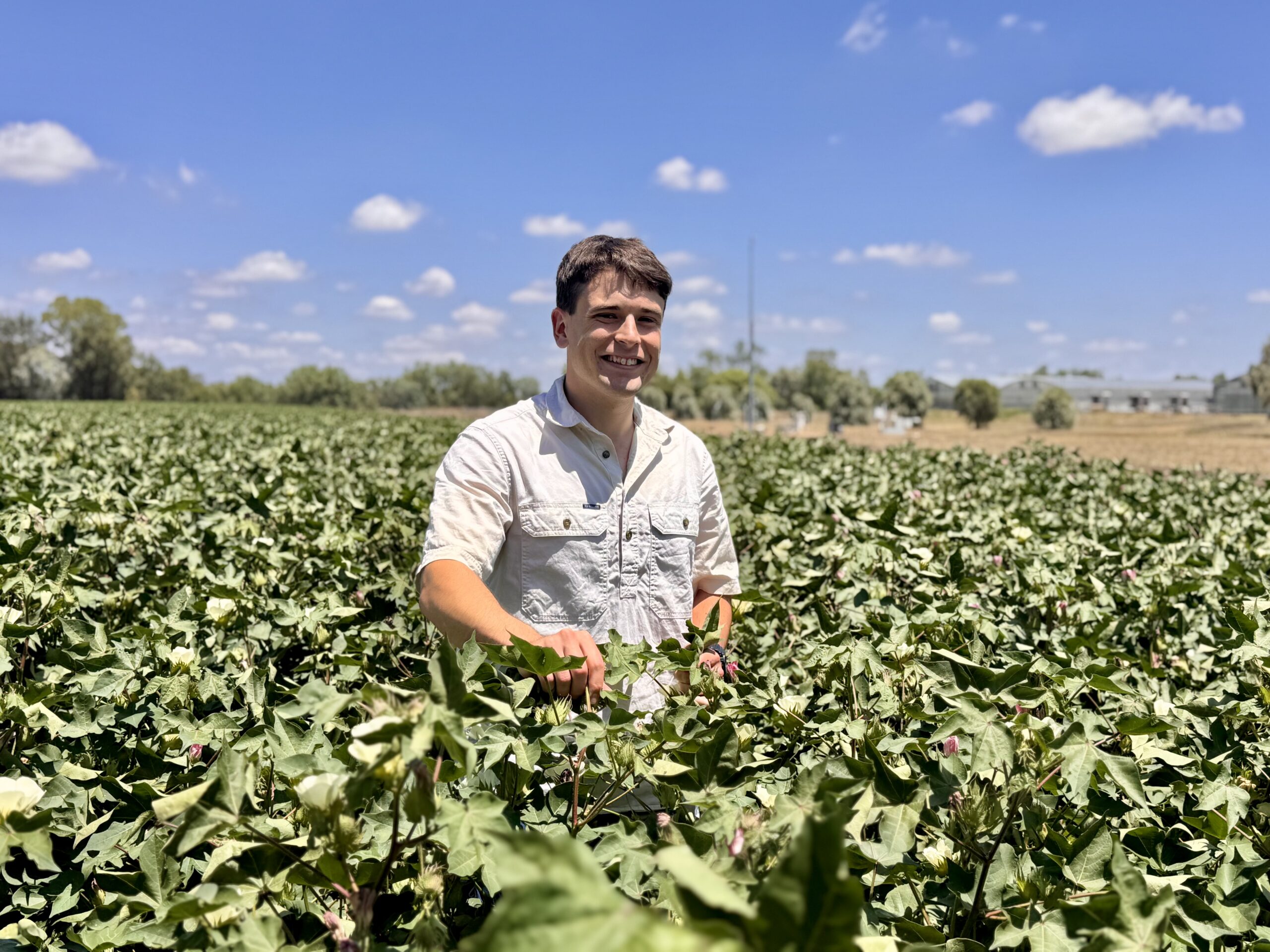
Having just finished studying Agricultural Innovation at Australian National University in Canberra, Julian is currently on a CSIRO Summer Studentship in Narrabri and that’s where The Courier caught up with him for this interview.
Julian was all smiles and seemed to be relishing the experience of doing some work outdoors (unfazed by the hot weather), learning new skills from some of the best, and applying what he learned in the uni lecture halls to the field.
As well as learning about plant physiology and pathology, Julian said his work over the summer at CSIRO has mostly focused on an early flowering development project, which will be presented to a symposium of other students.
“It’s been unreal,” he said.
“I’ve been working with some fantastic people, expert leaders in their field.
“Being a 2024 Horizon Scholar has opened doors I never expected.
“I mean, I don’t know anyone else my age who’s been able to go up to Kununurra like I did and the gain work experience there – the Horizon scholarship has been unreal for opportunities like that. It was an unbelievable place; I really didn’t want to leave.
“The network and connections I’ve built have helped me forge a career in agriculture.
“Ag is an industry that’s here to stay, which is why science, research, development and extension are so important for its sustainability.
“The most rewarding part of this scholarship has been the people I’ve met and the relationships I’ve formed.
“After spending a year on a cotton farm, I fell in love with the industry – it’s incredibly innovative and constantly evolving. And now being sponsored by CRDC has been amazing because they’re forward-thinking and always looking to support young people in the industry.
“I would encourage anyone thinking about applying for a Horizon scholarship to have a go – because you will learn so much and be part of a community that you’ll have for life.”
While completing his CSIRO placement, Julian has dived head-first into the Narrabri community, joining a local cricket team to meet new people and he’s soaked up the chance to explore the region too.
It’s clear Julian’s ‘lap around Australia’ in the family caravan all those years ago has left a positive and lasting impression, with the young student happy to spend time in different towns and make the effort to easily fit in with locals.
“I guess it taught me ‘home is where you make it,’” said Julian.
“I’m into hiking so Kaputar has been great, I’ve been to Yarrie Lake, I did my Christmas shopping in Wee Waa.
“Our team didn’t make the cricket finals, but my parents are coming up this weekend, so we’ll go and watch and it will be good to show them around,” he added.
Julian said he was ‘very impressed’ with the research stations in the Narrabri Shire – from Myall Vale site to the Plant Breeding Institute – and he thought it was fantastic the work was being undertaken in country areas.
“It’s great, much better than the city. I think Narrabri’s a good town.
“I heard Narrabri has the highest rate of PhDs per capita.”
In terms of what’s next for Julian, “I’m doing my honours year at uni back in Canberra this year and I think research agronomy is definitely where I want to end up,” he said.
“Agriculture is here for the future and it’s only growing.”
AgriFutures managing director John Harvey added a Horizon scholarship not only provided recipients with financial support, but also invaluable development opportunities that set them up for a long-term career in the rural industries.
The scholarship program is a collaboration between AgriFutures and industry groups that provides students with a $10,000 bursary over two years, as well as professional development and networking opportunities to a total value of over $20,000. It is open to students enrolled in full-time study at an Australian university, who are studying an agriculture-related undergraduate degree or a Science, Technology, Engineering, Maths/Finance (STEM) degree with relevant majors that align to agriculture.
“AgriFutures Australia is committed to supporting the next generation of leaders that will shape the future of the industry,” Mr Harvey said.
“The strength of this program lies in the wide diversity of its applicants, bringing together people from non-traditional agricultural backgrounds like those who grew up in the inner-city and remote students from cattle stations in central Queensland or mango plantations in the Northern Territory.
“This diversity is not only vital for addressing future workforce challenges, but also reflects the industry’s growth and unlocked potential, bringing forward incredible new ideas each year.
“For 15 years, the The Horizon Scholarship Program has helped more than 300 students, and we are so grateful to be working alongside this year’s sponsors to help foster the next generation of innovation.”
Applications close Monday, January 26.
To order photos from this page click here