


While reading The Courier on January 22, 2026, particularly the section titled “From the Courier 1965 Archives”, I was reminded that the first registrations under the second National Service Training Scheme (1965-1972) commenced that year.
All males who turned 20 years of age between January 1 and June 30, 1965, were required to register for National Service between January 25 and February 8, 1965. These men were called up to perform two years’ (later 18 months) continuous full-time service in the Regular Army Supplement, followed by three years’ part-time service in the Regular Army Reserve. When the scheme was introduced, the government planned to raise 4,200 servicemen during the second half of 1965, then 6,900 annually thereafter. In August 1965 Prime Minister Menzies announced that from 1966 the annual intake would be maintained at 8,400 (two intakes of 4,200), resulting in an Army strength of 40,000.
There were two registration periods each year, each lasting a fortnight and widely publicised. The Army provided free meals, accommodation, uniforms and work clothes, and medical, dental and hospital treatment. Unmarried soldiers of private rank were paid $34.16 a week. Between 1965 and December 1972 over 800,000 men registered for National Service. Some 63,000 were conscripted and around 16,000 were sent to Vietnam, although this figure is often contested. Males could elect to serve six years of part-time service in the Citizen Military Force (CMF). Nashos in this scheme could serve in Australia or overseas, including Vietnam, Malaysia (including in the Indonesian Confrontation), Singapore, and Papua New Guinea. In December 1972, Prime Minister Gough Whitlam announced the end of peace time conscription. Those National servicemen who did not wish to complete their term of service were discharged immediately. Others elected to stay on and were rewarded with lucrative benefits.
When my own turn came, I collected the eight-page Registration for National Service form from Mr Phil McGregor, District Officer, District Employment Office, 60 Maitland Street Narrabri – present site of Helloworld Travel. I completed the form on January 21, 1967, and submitted it with little reflection. Registration was compulsory, and failure to comply carried severe penalties, including the possibility of up to two years’ imprisonment and the prospects of a criminal record. At the time, I was particularly conscious of the risk this posed to my banking career of five years’ standing – Rural Bank of NSW 98 Maitland Street, Narrabri – present site of the Bridge Medical Centre.
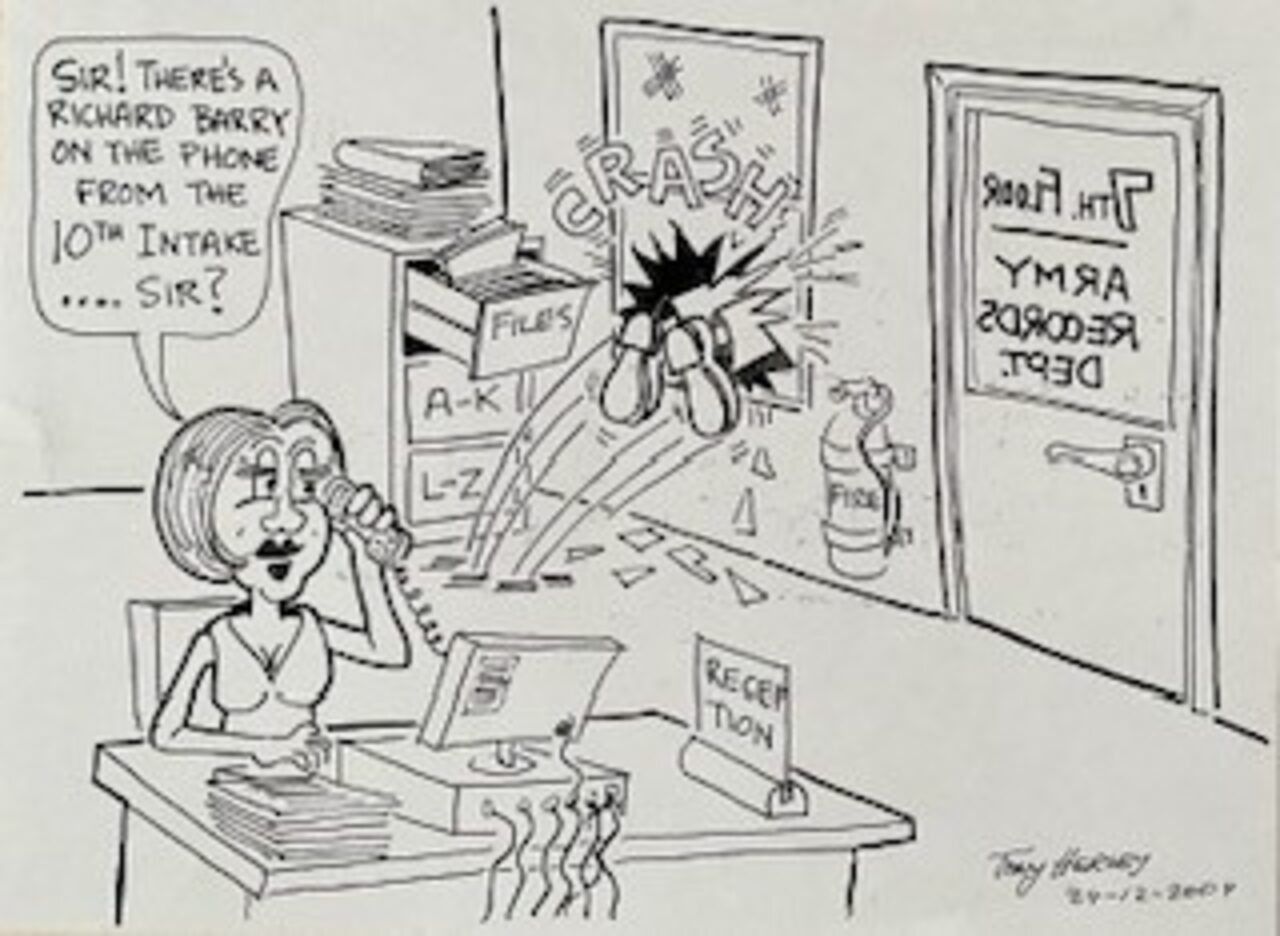
Having never previously won a raffle or a lottery, I gave little thought to the outcome and continued with my daily life. Sometime later, however, a brown rectangular envelope bearing the embossed words On Her Majesty’s Service (O.H.M.S) arrived at the Post Office. My girlfriend immediately recognised its significance. She took the enclosed registration card, tore it into pieces, and discarded them in the gutter. When I presented myself to Colonel P.H.G.Oxley Commanding Officer of the Third Training Battalion at Singleton NSW and handed in my patched-up registration card he was not surprised. He had seen it all before. The reality was that I had been selected in the “birthday ballot”, which ultimately resulted in a one-way all expenses trip to South Vietnam aboard HMAS Sydney. Contrary to popular belief we were not forced to fight in Vietnam. I still have a copy of the document I signed giving my consent and witnessed by my platoon commander.
National servicemen also marched into the First Recruit Training Battalion at Wagga Wagga (Kapooka) and the Second Recruit Training Battalion at Seymour Victoria (Puckapunyal) during 1965 -1972.
On September 13, 1967 I received the official Call-Up Notice and a Travel Warrant for a one-way second-class ticket on the steam train from Narrabri to Singleton on October 4, 1967. My father had to sign a consent form to allow me to undergo any surgical operation and the administration of anaesthetic because I was under the age of 21. As ordered, I had attended the surgery of Dr Charles Houston Horsley on July 31, 1967 at 1930 hours for a full medical examination at 158 Maitland Street Narrabri – opposite present day Coles supermarket. I actually faked my eye test by covering my lazy eye both times to read the chart.
I arrived back in Narrabri from Saigon unannounced late September 1967. I knocked on the door of the flat in Campbell Street, Narrabri, and gave my father an enormous shock. A few weeks later I recommenced work back in the bank although I found it extremely difficult to assimilate back into civilian life.
At the Narrabri RSL War Memorial, a plaque records the names of 54 men from the town and surrounding district who served in South Vietnam. Some of these men were enlisted personnel. I do not know the total number of men who registered for National Service, nor the precise number who were conscripted from this area. It is estimated that the youngest of those men would now be approximately 74 years of age, with most being near or over 80.
I also have no information regarding the number of men from this area who registered under the first National Service Training Scheme (1951-1959). It required nearly all 18-year-old males to be registered for national service and undergo between 3 and 6 months of full-time training in one of the armed forces followed by a part-time service commitment in either the Royal Australian Naval Reserve, Citizen Military Force, or Citizen Air Force.
We were considered old enough to pay taxes, marry, drink legally, drive cars, and be ordered to kill other human beings in the name of the nation. Yet we were not considered mature enough to vote. That basic democratic right was denied to us until March 21, 1973, long after many had already been sent to war.
As if that hypocrisy were not enough, many Vietnam veterans were then turned away by parts of the very organisation that claimed to stand for returned service personnel. On August 14, 2023, Ray James, President of RSL NSW, finally issued a formal apology, admitting that some sub-branches rejected Vietnam veterans under the absurd and insulting belief that they “didn’t fight in a real war.” For those who were excluded, dismissed, and shamed, that acknowledgement came not as reconciliation, but as confirmation of a deep and lasting betrayal.
We pause to remember that more than 200 national servicemen died on active service overseas and others died while serving Australia. Although many young men were proud to serve their country in uniform, national service came at a personal cost for all Nashos, irrespective of the nature and location of their service.
On 3 October 1987 I was able to join 22,000 other Vietnam veterans to march through the streets of Sydney in the Australian Vietnam Forces Welcome Home Parade. Prime Minister Bob Hawke noted: “I firmly believe that this parade will be the culmination of a long process of reconciliation and community acceptance of its obligations to the veterans of Vietnam. I believe we must honestly acknowledge that our involvement in Vietnam did cause deep divisions in the Australian community. But whatever our individual views on the merits of Australian involvement, we must equally acknowledgement, courage and integrity of our armed forces who served in Vietnam.”
To mark the 75th anniversary of National Service, the Department of Veterans’ Affairs (DVA) will be holding a National Commemorative Service at the Great Hall, Australian Parliament House, Canberra on National Servicemen’s Day, February 14, 2026. The service will also be broadcast from 10:30am to midday nationally by the ABC and streamed online to provide members of the community the opportunity to acknowledge the anniversary from their home.
In the meantime, the Statistical Section of DVA has advised there are some 2500 national servicemen from across the nation, through no fault of their own, have not been fully recognised with a campaign medal for their lawful and meritorious service in Vietnam. The campaign, which I commenced in 1996, is still being pushed forward with impressive support from all quarters.
On a separate matter, due to a fresh interpretation of the eligibility criteria, I have personally assisted 135 of these men to receive their medal in the post. Their testimonials are heart-breaking especially from the families of those who have passed since coming home. There is a lot more work to do because my confidential list of affected Vietnam veterans now exceeds 400.
Richard Barry OAM
Ex-National Serviceman.
*If you wish to know more about my time as a Nasho in the Australian Army, please feel to check my book “The Tenth’ (ISBN 978-0-646-5567 4-1) in the Narrabri Shire Library.
To order photos from this page click here