Only 717 of the nearly one million Australians who served in the Second World War remain with us. For the first time, the number who died during the past 18 months exceeded the number still living, underscoring the fading away of the fabled generation that defended Australia and the free world in its hour of direst peril.
According to figures from the Department of Veterans’ Affairs, their average age is now 100. They comprise 597 men and 120 women, ranging in age from 96 to 108. By the end of this decade, few, if any, are likely to remain. These figures were reported in The Australian on 24 April 2026.
One only has to visit the Narrabri RSL memorial to appreciate the enormous contribution made by the men and women of this district during the Second World War. Their names are a permanent reminder of the sacrifices made by an earlier generation.


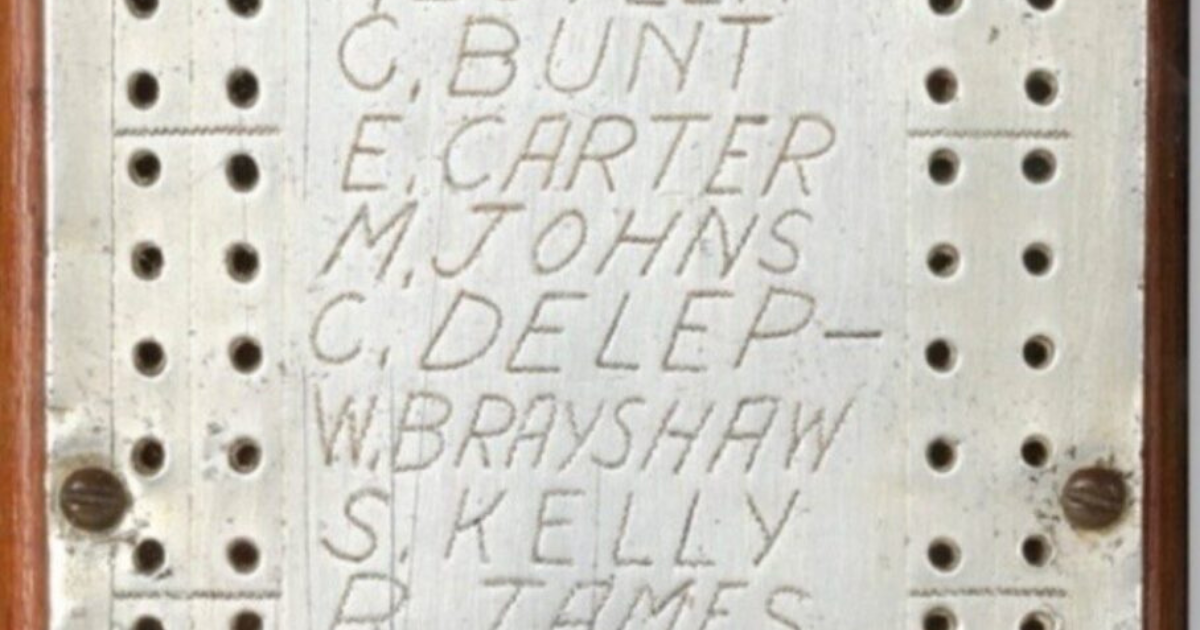
Among the many reminders of that generation is a roughly fashioned crib board displayed in the War Room of the Old Gaol Museum in Narrabri.
The crib board was made by John Condon, who served with the 10th Army Medical Corps. While a prisoner at Changi, John gathered pieces of wood and scrap metal and fashioned the board as a keepsake for “Aunty” Mary Griffith of the Narrabri Telegraph Hotel.
A little piece of every Narrabri boy in Changi went into that humble memento. As John worked on it, the men took turns using a nail to make holes or scratch the letters of each name into the board. A Rising Sun badge was placed at the top.
It is, quite literally, a small piece of Hell Camp Changi brought home.
John Condon was seriously ill and knew he was unlikely to survive. Yet he insisted that other prisoners carry the memento home to Aunty Mary. He died on 24 June 1945.
Mary and Alan Griffith owned the Telegraph Hotel from 1938 until 1951. During the war years, Mary wrote to numerous Narrabri servicemen and sent dozens upon dozens of hampers, tins of food, fruit cakes, puddings and canteen orders to those serving overseas.
The servicemen held her in such high regard that they affectionately called her “Aunty Mary”.
The crib board is inscribed to Mrs Griffith from:
C. Bunt, D. Barret, T. Butler, W. Brayshaw, A. Cameron, E. Carter, J. C. Condon, J. Delaney, C. Delep, R. Gibbs, M. Griffiths, R. James, M. Johns, S. Kelly, J. Logan, R. Melbourne, C. Picton, R. Richards, J. Rooney, L. Smith, W. Smith, M. Thorley and O. Vincent.
These were Narrabri boys who became prisoners of war.
We would know far less about these men and their experiences had it not been for Narrabri-born Haig “Jock” Logan, NX41219, of the 2/30th Battalion. Jock was taken prisoner by the Japanese on 15 February 1942 following the fall of Singapore.
We are fortunate that Jock kept a wartime diary. It begins in January 1944, after his work with “F” Force on the Burma–Thailand Railway had ended, and four months before his return to Changi prisoner-of-war camp.
Among the Australian prisoners briefly mentioned in Jock’s diary are 18 soldiers from Narrabri Shire or its immediate vicinity. Most were captured with their respective units on the same day as Jock, although their experiences of captivity—and their ultimate fate—varied greatly.
Jock lived at 45 Barwan Street before enlisting on 6 September 1940. His parents were Henry and Ethel Logan. His sisters were Mrs Heather Cameron, Mrs Jessie Watt, Mrs Muriel Cramsie and Mrs Helen Mead. His younger brother, Robert “Bob” Logan, enlisted in the RAAF.
When Singapore fell, Jock was soon on his way to Changi with thousands of other newly captured Australian servicemen.
Large numbers of prisoners were subsequently sent to work in appalling conditions on the Burma–Thailand Railway and at other locations throughout the Japanese wartime empire. They were utterly unprepared for the human suffering they would encounter.
We will never fully know what these men endured.
More than 22,000 Australian servicemen and almost 40 nurses were taken prisoner in the Asia-Pacific region during the early months of 1942. By comparison, German and Ottoman forces captured approximately 4000 Australian prisoners of war throughout the whole of the First World War.
In total, more than 8000 Australian POWs—around 35 per cent—died during captivity. More than 2800 died while working on the Burma–Thailand Railway.
Many became victims of the indifference, brutality and systematic mistreatment of their captors. Tragically, more than a thousand prisoners died when Allied submarines torpedoed the unmarked ships transporting prisoners around Japan’s wartime empire. The murder and mistreatment of Australian nurses is another terrible chapter in this history.
Little detailed research has been undertaken into the backgrounds of Australian POWs and how those backgrounds may have influenced their chances of survival. What we do know is that these men had volunteered to serve under Australian legislation. Before 1943, national service could be used only for the defence of Australian territory.
When former prisoners were later asked how and why they had survived, their answers varied.
Some spoke of military discipline. Others stressed individual initiative. Some stole and scrounged from guards—and occasionally from one another. Most spoke of helping their mates and relying upon them when circumstances became desperate.
And all needed luck.
Jock’s diary records his work on the “drome” and at Changi, where he worked in the gardens and with goods trailers. He constantly encountered familiar faces.
On or about 4 September 1945, Jock and many of the Narrabri-region POWs mentioned in his diary were reported alive in Singapore and awaiting repatriation to Australia.
His diary contains many individual stories about his fellow prisoners. He also reflects upon three Narrabri boys who did not make it home.
With the end of the war came the reckoning. Many Japanese guards were charged with war crimes committed against prisoners and civilians. Hundreds of former prisoners gave statements describing what they had witnessed and endured.
In Australian trials, 922 men were tried and 641 were found guilty. Of the 148 sentenced to death, 137 were executed.
Jock Logan went on to live a remarkable life.
He was a great sportsman and excelled at football, representing Narrabri during the Spicer Cup–Robinson Shield era. He was also a keen swimmer. On a return visit to Narrabri just before Christmas in 1979, it was noted with some interest that Jock swam one mile every day in the Narrabri pool.
He was a keen traveller and remained involved in RSL affairs, Legacy and Freemasonry. Few people were aware of the extent of his generosity to worthy causes. His spontaneous acts of kindness benefited many individuals and organisations.
A trust established in his name subsequently benefited six junior sporting bodies, the Scouting movement and the High School Parents and Citizens Association in the Palm Beach–Currumbin area.
Jock passed away following a relatively short illness on 14 July 1980.
Another remarkable Australian POW was Dr Rowley Richards, MBE, OAM (1916–2015). As a medical officer on the Burma–Thailand Railway, he witnessed an unimaginable catalogue of misery, horror, sickness and death. Through his courage and determination, he saved countless Australian lives while tending to men weakened by starvation, tropical disease and the systematic brutality of their Japanese captors.
In 1996, we travelled to Kanchanaburi, approximately 133 kilometres west of Bangkok, and walked along the infamous railway line. We then walked through Hellfire Pass.
It was at this rocky cutting that hundreds of Australians lost their lives, and where the ashes of Sir Edward “Weary” Dunlop were laid to rest in 1994.
The 100-metre-long cutting was carved through a rocky cliff face by malnourished and mistreated prisoners using rudimentary tools. The path down to it is short but steep. Here, Australians and other Allied prisoners worked day and night under appalling conditions and impossible time constraints to construct the 415-kilometre railway stretching from Thanbyuzayat in Burma to Nong Pla Duk in Thailand.
The cemetery at Kanchanaburi is beautifully maintained. During our visit, we went to the grave of my wife’s uncle, who was murdered, along with other prisoners, only days after the war had ended.
To this day, I remain almost lost for words when I think of what happened.
The Japanese military hierarchy was urgently demanding that the railway be completed as quickly as possible for obvious strategic reasons. Yet, at the local level, guards deliberately and systematically starved prisoners and subjected them to continuous beatings with rifle butts.
Hundreds died simply trying to obey orders and complete the work that might allow them to stay alive.
That is why the stories of these men must never become merely names on a memorial.
Behind every name was a son, a brother, a husband, a mate—a young Australian who left home believing he would serve his country and return.
Some did return.
Many did not.
The humble crib board in the Narrabri Old Gaol Museum is therefore much more than an old piece of wood. It is a tangible link to those Narrabri boys who endured Changi and the Burma–Thailand Railway, and to the mateship that helped some of them survive.
As the generation that fought the Second World War passes from us, the responsibility to remember becomes ours.
On this Remembrance Day, let us never forget these brave Australians and all those who suffered and died in captivity.
May they rest peacefully.
Lest we forget.
With thanks to The Courier, Susan Mason and the Narrabri Old Gaol Museum.
To order photos from this page click here