



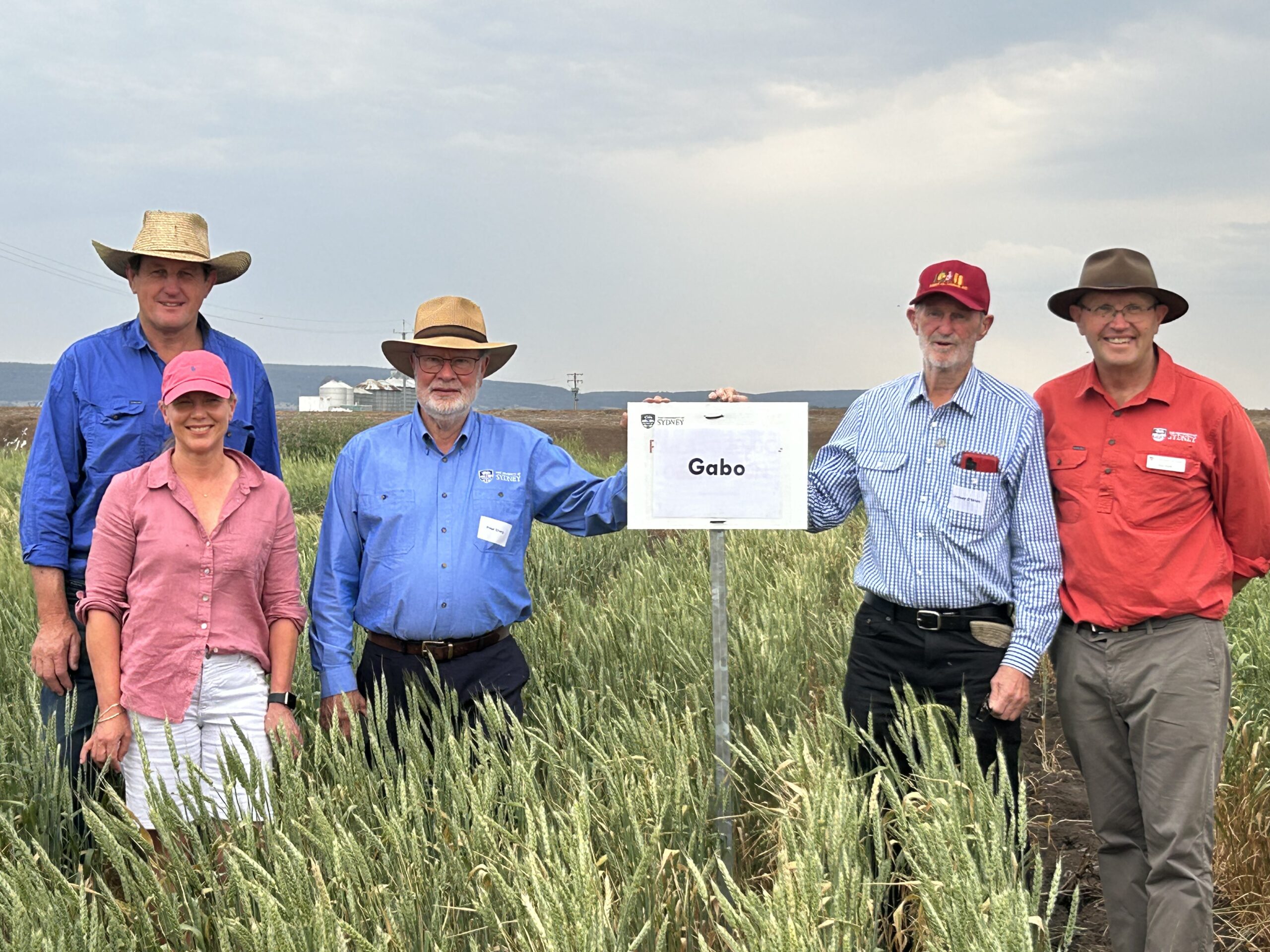
A field day and book launch has marked the 80th anniversary of the naming of the Gabo wheat variety.
The University of Sydney and Gunnedah Shire Council co-hosted the festivities, held at the former university site near Gunnedah and later at the town hall.
Among the attendees were descendants of the original families, university and shire representatives, and the Governor of NSW.


The Gabo name continues, with the site now owned by local farmers Tim and Mandy Gavin under the ‘Gabo’ name.
Gabo was a ground-breaking wheat variety that has benefitted farmers, researchers, rural communities and cities.
Its history has been extensively documented in the book written by Honorary Associate Professor Dr Lindsay O’Brien and Emeritus Professor Dr Peter Sharp.
The Australian wheat industry was in dire straits during the 1930s. The period of the Great Depression resulted in high production costs and low wheat prices threatening the viability of wheat growing. The Commonwealth established a Royal Commission to investigate the financial viability, marketing system and the quality of the crop. Marketing of the crop was a state-based responsibility and was based on the Fair Average Quality (F.A.Q) system. All wheat from each year’s crop was binned together and a new F.A.Q. standard created each year. Growers were not paid a premium for high quality wheat.
Soft-grained varieties with weak dough properties and poor bread making quality dominated production. While they performed well for growers, they were troublesome for the milling and baking industries.
Consumers were missing out by not having access to good quality bread.
Two factors associated with soft wheat compounded the problem for the milling and baking industries. Firstly, soft wheat is difficult to mill into flour. They must be fed into the mill rolls at a slower rate and sifting the flour takes longer. Starch granules that make up the bulk of flour are not fractured during milling, so the flour takes longer to sieve, increasing the costs of milling. Secondly, for the baker, soft wheat flour takes up less water when the flour is mixed with water into a dough. This results in less loaves per ton of flour and the quality of the resultant bread is poor because the flour lacks the quality of strength.
Growers faced the yearly uncertainty posed by seasonal climate variability. Optimistically, they looked forward to the better rainfall years, as they deliver higher grain yields and better farm returns. However, in northern NSW and southern Queensland, such years favoured the development of the fungal disease stem rust which severely reduced grain yield, farm returns and produced grain with reduced milling and baking quality.
Stem rust has threatened wheat growing since the days of European settlement. Pioneer wheat breeder William Farrer attempted to breed rust resistant varieties but his efforts resulted in earlier flowering varieties such as the variety Federation (1901) rather than them being resistant. The earlier flowering enabled the growing area to move inland to more arid environments that are less favourable for rust
development.
Walter Waterhouse commenced his wheat rust studies at the University of Sydney in 1922 with the goal of developing stem rust resistant varieties. His first two resistant varieties Fedweb and Hofed were named and released in 1938. Development of them would not have been possible without the support of his former Hawkesbury Agricultural College classmate, Charles Henry Beeson who had settled on the land at “Leyburn” west of Gunnedah in 1908. Beeson provided land, his time and that of his farm workers to plant, maintain, take observations and to harvest breeding plots using his farm machinery.
Fedweb and Hofed never became big production varieties but they proved it was possible to breed stem rust resistant varieties. By 1933, Waterhouse had a F2 generation population of the cross of Bobin/Gaza/Bobin where rust resistant plants were selected at Hawkesbury Agricultural College. Later generations were planted and selected at Hawkesbury and on Beeson’s property west of Gunnedah. Waterhouse was seeking to capture the drought attributes from the durum parent Gaza, so one generation at Leyburn was planted on a special harsh piece of ground. After region wide testing by growers and Departments of Agriculture for yield and internationally for rust resistance, this population gave rise to the variety that was named Gabo in 1945.
Seed production of Gabo was conducted by Claude Hathway on his property Woodleigh. Starting in 1940 with just 55 grains he had increased this to 2753 bags of seed by the end of 1945. Gabo quickly became the most widely grown variety in northern NSW. By 1954 it was the most widely grown variety of Australia. It was a foundation variety of the International Green Revolution and later Gabo genes returned to Australia as parents for Australian breeding in varieties bred overseas in the Green Revolution .
Gabo was popular with growers because its rust resistance combined the good agronomic attributes of high yield, short and strong straw, early maturity and ease of harvest. Its hard grain was a boon for flour millers and its flour produced more loaves per ton of flour for bakers. The consumer won by having access to good quality bread.
The dominance of poor-quality soft wheat had flour millers offering payments to growers to encourage them to grow lower yielding hard-grained wheat they could blend to improve milling and baking quality. Millers soon started offering premiums to growers for higher protein content parcels of Gabo. Discontent amongst growers in differences in premium payments for what they knew was the same quality wheat, had growers band together and the Premium Wheat Growers Association formed in northern NSW.
A succession of stem rust resistant, hard-grained varieties bred by the University of Sydney followed, consolidating the change across wheat industry value chain sparked by the release of Gabo. Change gathered momentum and pressure from grower organisations across the country brought about change to the marketing system. Grades based on variety and protein content best suited to the range end-products made from Australian wheat replaced the F.A.Q.
So successful was the transformation started by Gabo, that there have been no yield losses from stem rust in northern NSW and southern Queensland since 1964. The domestic milling and baking industry predominantly uses hard-grained wheat varieties. The export market which accounts for the sale of up to 80 per cent of annual production successfully competes in the international trading market. It does this by having grades based on differences in variety with their intrinsic quality attributes, segregated and binned according to variation in protein content driven by regional and seasonal differences. These changes were all initiated by the development and subsequent popularity of Gabo across the value chain after it was named in 1945.
To order photos from this page click here




What a great story.
The bit about how the Gaza parent seed came to Australia was not uncovered until after the book was published.
We need a second edition!
(The story just keeps on getting better).
The success of Gabo was the result of a convergence of; its rust resistance, its capacity to grow in the heavy black soils, the use of fossil fuel powered farming machinery capable of working the heavy black soils of the Liverpool plains and farming practices that accommodated the vagaries of working a flood plain, like keeping enough seed grain for a second sowing if the first is washed out and using a hard pan as seed bed.
Prior to the wide spread availabilty of kero tractors etc. in the early 1930s, farming was by working horses that only had the strength for lighter sandier soils like those found on the hills around the flood plain. For decades the black soil plains was grazing country because it simply could not be worked.
Today, unfortunately, we have a convergence of a different kind. Its now a convergence of; soil degradation, lack of soil moisture and increasing ambient air temperatures.