


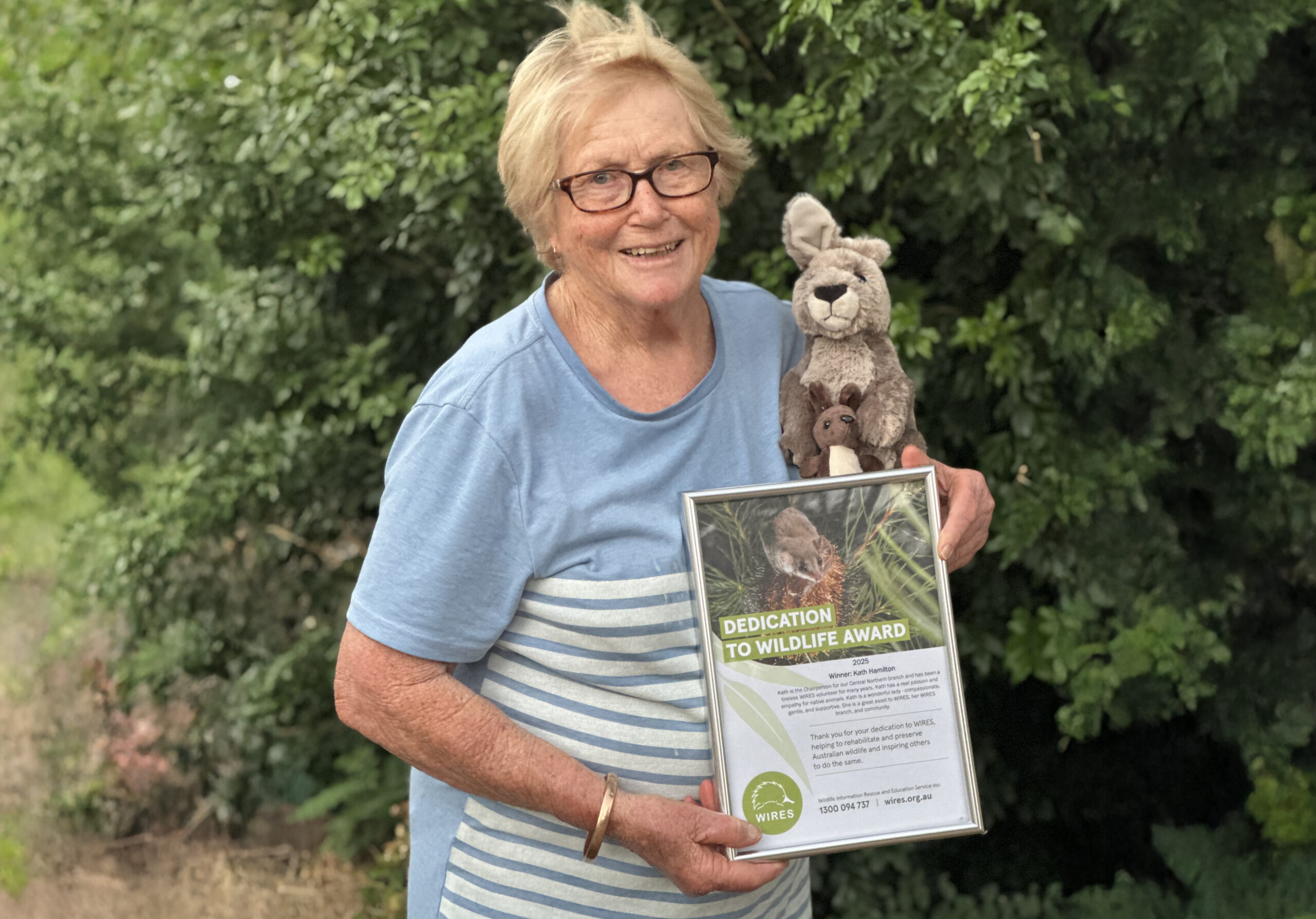
Former Wee Waa Public School teacher Kath Hamilton’s extensive service to WIRES has seen the local volunteer named the recipient of a Dedication to Wildlife Award.
“I feel very honoured because believe you me, there are so many more carers who are more deserving of that award,” said Kath humbly.
“For example, one member has been a WIRES volunteers for 35 years.”


Kath told The Courier she is driven to make a positive difference.
“I look at the way our fauna is disappearing.
“It concerns me the number of roos and wallabies who are just lying in the middle of the road and people just drive on. It only takes a few minutes to stop, to check the pouch.
“It moves me to see our native animals not being cared for properly, they are not pets.”
WIRES volunteers work to ensure the wellbeing of our wildlife by caring for sick, injured or orphaned native animals.
Kath, who is the current chairperson for the Central Northern branch, has been a tireless WIRES volunteer for many years.
As a recipient of the award, Kath was described as someone who had a real passion and empathy for native animals.
“Kath is a wonderful lady – compassionate, gentle and supportive. She is a great asset to WIRES, her WIRES branch, and community,” her award citation read.
Kath has held a fondness and fascination for animals for her entire life, however, her journey with WIRES started almost nine years ago after she received an orphaned wallaroo from her son-in-law, Darrell Tiemens.
It was not until Kath made an enquiry with WIRES about the correct feeding formula that she realised she was required to be legally registered to undertake wildlife rescue. She subsequently enrolled in a WIRES training course to formalise her role as a volunteer carer.
The registration course is regularly updated to reflect best practice in safe rescue, handling, feeding and animal care. Volunteers are also required to contact WIRES to obtain a case number and, where necessary, seek veterinary assistance to assess an animal’s condition.
Many people may be unaware that rescuing and raising orphaned native wildlife without the appropriate accreditation is illegal, as untrained handling can cause unnecessary pain and distress.
This requirement applies to most native birds, with the exception of species that are prolific in the region, such as cockatoos and galahs. In the case of injured birds, WIRES or a local veterinarian should always be contacted for advice. Birds with broken wings rarely recover, as the delicate bone structure makes successful repair extremely difficult.
For 365 days a year, 24 hours a day, Kath along with the WIRES network of call centres and volunteer carers, respond to incidents involving animals of all kinds. Each call includes a case number, location and description, with details recorded in the WIRES database through to the outcome of the rescue. This data helps inform ongoing training and wildlife care recommendations.
At the end of every year, Kath said National Parks and Wildlife Services collect information from each WIRES volunteer about everything listed on their call sheets.
While most animals eventually mature and move away, they often remain close by. Kath spends much of her time preparing litres of specialised formula, with different mixtures required for the various native animals.
Not all rescues, however, go to plan.
In an earlier Courier article, Kath recalled a call-out involving six baby emu chicks reportedly running along the Kamilaroi Highway at the Turrawan Road junction.
The caller, a passing traveller, estimated the chicks were about 15 centimetres tall. Upon arrival, Kath discovered the birds were actually closer to 50 centimetres tall, uncontained and scattered across paddocks and roadside. She advised WIRES that attempting to catch them was impractical, and the rescue was ultimately declined.
One particularly memorable rescue involved a much-loved cockatoo named Jimmy Boy, who was nursed back to health after suffering a broken leg. Birds with leg injuries cannot be released until they are able to perch again. Jimmy Boy lingered on the farm long after his recovery, often flying off to locate Kath’s son Richard and his partner Darrell while they worked in the paddocks.
One day, however, Jimmy Boy disappeared. During a visit to neighbour Pat’s home, Kath was surprised to learn Pat had “a new cockatoo with a funny leg”. Sure enough, it was Jimmy Boy — now affectionately renamed “Dicky Foot” — who had settled happily into his new surroundings. He has remained there ever since.
Animals and birds alike, once healed or mature, often move on but rarely venture far from their sanctuary home.
It is a testament to Kath Hamilton’s gentle and nurturing nature that so many of the animals she cares for form bonds they seem reluctant to leave behind.
“We are always looking for volunteers,” added Kath. “People who will help with transport or will help care.
“They do need to do a course, which is online through WIRES and easily accessible.
“The volunteer work is so fulfilling.”
To order photos from this page click here