


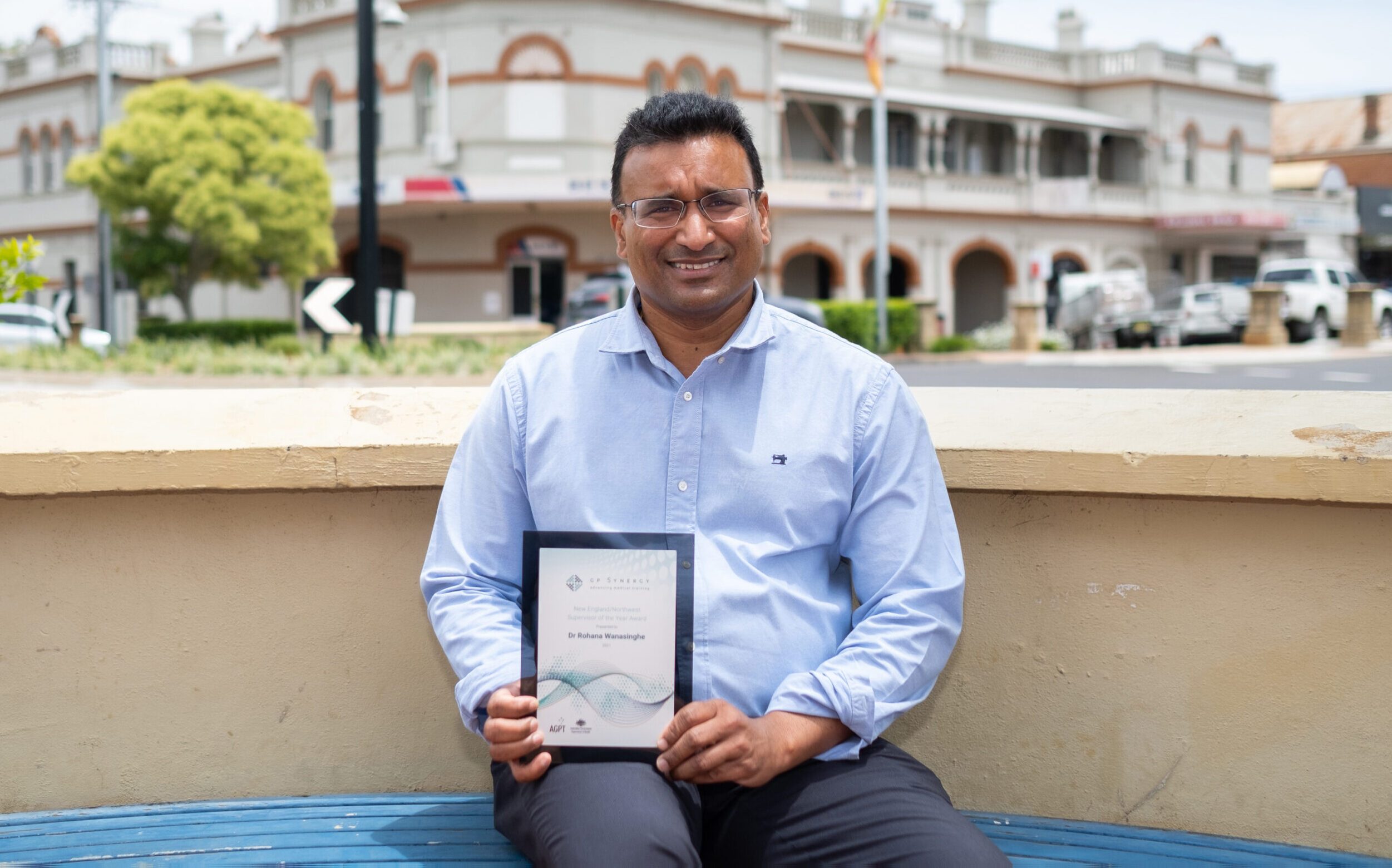
Bridge Medical Centre’s Dr Rohana Wanasinghe was recently recognised for his dedication and outstanding contribution to training the next generation of GPs when he was named the GP Synergy supervisor of the year for the New England/Northwest training region.
The highly-respected Narrabri GP spends countless hours each week training aspiring doctors at his practice while externally coaching others to pass exams, both of which he excels at as he simultaneously runs the local practice while attending to his many patients each day.
He told The Courier that while he was both proud and honoured to receive the award; he insisted he could not take all of the credit, and he thanked the entire Bridge Medical Centre team.


“We have a very good team here,” Dr Rohana said.
“We have our doctors as well as four nurses and great reception staff, about 16 people working here now.
“Without a good team, this would not work.
“I think this award is more for the practice. It is not for me only.
“It is a collective effort from everyone, especially our practice manager and my wife, Dr Dilini, who is also a GP at Bridge Medical Centre and is actually helping me to teach the newly-appointed doctors.
“I really appreciate her support in managing the practice, supervising and assisting the other doctors at our practice, as I have several days of surgery at the district hospital each week, as well as managing our home and kids; she has a huge workload too. I think a large part of this award belongs to her as well.
“What we have done here is good for the practice as well as for Narrabri.
“We work very hard to get doctors to Narrabri, and part of that is getting trainees to come here.
“We do our best to keep them happy too.
“It is a hard job, but we manage. If we don’t commit to what we do, then we won’t get the trainees.
“We have six doctors here now (at Bridge Medical Centre) and we will continue to recruit more doctors when required.
“My intention is we need to expose the medical students and doctors in training to rural general medicine so that they stay.
“The more we do for them, then maybe one or two will stay, if not in Narrabri, at least in another rural town.”
Dr Rohana and Bridge Medical Centre became accredited for GP training in 2018 in order to provide trainee GPs with an opportunity to experience health care in a rural setting.
During the past three years, their exceptional work has seen the practice grow from two doctors in 2019 to six at present.
That benefits the town, the wider shire and all of the trainee doctors themselves.
Dr Rohana relocated to Narrabri almost eight years ago and has spent many of those years determined to create effective methods to attract more doctors to the town.
He explained that it was a constant uphill battle to provide an adequate number of doctors at the practice to service the Narrabri Shire.
“Many people think the government send doctors here, but they do not,” Dr Rohana said.
“There are programs in place, but if they were working, we would have doctors.”
“So, us doctors need to work on new things to get doctors continuously coming here. We need to find them.
“One of the things we have done is become a supervisor for GP Synergy, and that way we can get trainees to come here to fill the gaps.
“When a trainee comes here, they’re here only temporarily for one year.
“That is just to fill the gaps. It is not constant.
“We have here now, Dr Huan. Even though he wants to stay until he finishes his training and gets qualifications, he can’t stay for more than one year.
“It will be the same with Dr Stephanie Miles, who has just started with us.”
The team at Bridge Medical Centre has recently welcomed another new doctor, Dr Manori, who has relocated to town as a part of the More Doctors for Rural Australia Program.
Dr Rohana explained that training new doctors as a part of the MDRAP program begins well before they are even approved to become trainees.
“Usually they have experience in other countries, but they need to pass an English exam to see if they are competent in speaking and writing English, an AMC (Australian Medical Council) exam to see whether they hold equivalent qualifications to a graduate in Australia, and the PESCI exam (Pre-Employment Structured Clinical Interview) to see whether they can manage as a GP in particular positions in Australia.
“For the AMC and PESCI exams, we actually coach the interested doctors in our own time to help them pass the exam so they can come and work here.
“So there’s a lot of work that we do behind the scenes that no one knows about.
“And we have to do that because usually Australian-trained doctors rarely come here.”
As stated, Dr Rohana believes that gaining experience in a rural general practice benefits future and aspiring doctors.
“It’s good exposure, and it’s not like what you get in a city general practice,” he said.
“There are lots of complicated patients with a lot of health issues that we manage here. That’s because we are far away from other services.
“You can learn a lot in rural areas that you can’t in the city practices.”
He said that he especially enjoyed living in Narrabri.
“I really like Narrabri. It is a very good community,” he said.
“It’s a friendly community. It is good for the kids as well as for us.
“There is less politics than there is in the big cities.
“We are lucky in Narrabri that we have a very good hospital too. For example, we have X-ray, CT, and ultrasound facilities.
“Even though it is rural, we are much luckier than a lot of the other country towns – there are three busy practices operating here in Narrabri so our community is very lucky.”
To order photos from this page click here