


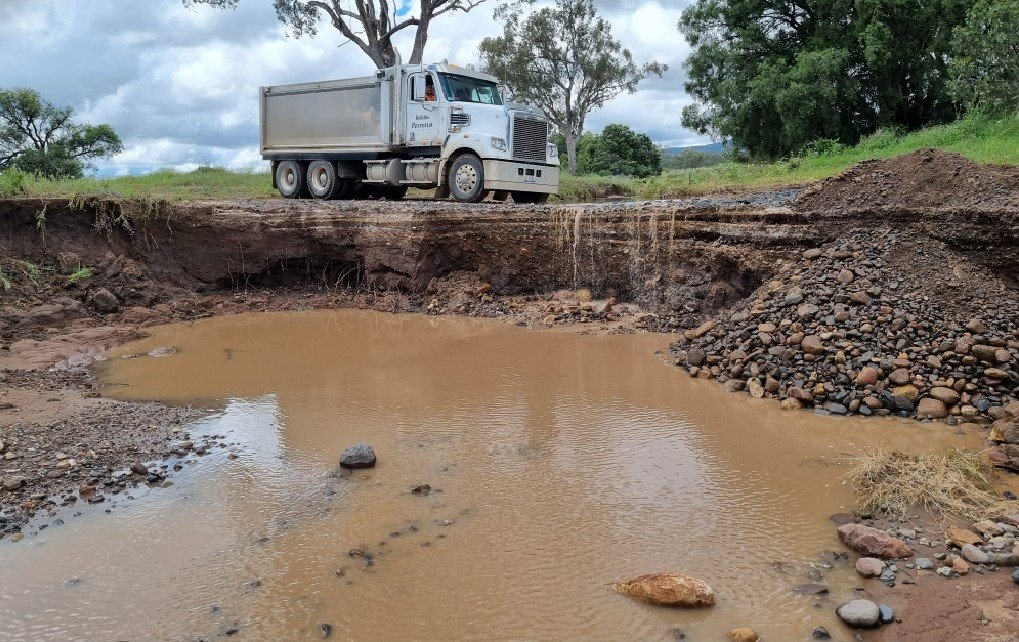
Narrabri Shire Council is facing the enormous task of widespread repairs to shire roads following the recent major flood event.
While the full extent of the damage is still not known, nor is the cost, the repair bill will stretch into the millions of dollars.
Council’s general manager Rob Williams and infrastructure delivery director Eloise Chaplain met with The Courier to discuss shire roads, the complexities of managing a 2343km road network as well as the widespread damage caused by the flood event and subsequent processes to source government funds for repairs.


The following questions were discussed by Mrs Chaplain and Mr Williams with The Courier.
Let’s talk about roads, the roads council manages and where the other levels of government come in.
Roads in the shire are divided into four categories – federal, state, regional and local.
“The Newell is a federal highway, and the Kamilaroi is a state highway. Both highways are the responsibility of Transport for NSW,” Mrs Chaplain said.
“However, they do tell council to do some maintenance work, and we have an agreement with them.
“They will ask us to do a job, we prepare a quote, and then there is an approval process to do that work – but it is their responsibility.”
Other state roads include crown roads as well as roads in national parks, so in Narrabri Shire’s case, part of Kaputar Road, to a point, is a state road while the remainder is a shire road.
Regional roads, examples of which are Killarney Gap Road and Pilliga Road, are managed by council. Limited funding is provided to maintain these roads.
Local roads include town streets and general shire roads – they are then broken down into their own categories depending on their use and level of traffic.
These are the responsibility of council and are managed using council funds.
Mrs Chaplain explained that a hierarchy is used to determine the service levels of roads and to prioritise repairs based on a road’s level of use.
“We’re reviewing that at the moment and getting recent traffic data. That will be presented to council,” she said.
“We will have quite an intense community consultation process next year to go through that.”
Is it true that Narrabri Shire is still waiting for disaster relief funding from previous flood events?
“The process is not straightforward. It is set by Resilience NSW … and we have to follow the guidelines,” Mrs Chaplain said.
There are three categories of works: Emergency works which are completed straight away to make the road safe; restoration works which are works that can be completed in the preceding three months, however, only nominated and approved works are completed; and finally, the restoration of public assets – the remaining damages are in this claim, and the process is similar to an insurance claim.
Estimation is required on every bit of damage lodged into the system with extensive pre-condition data, damage evidence, estimates of costs and photos to prove the damage.
Each restoration has to be approved prior to work commencing.
Mrs Chaplain explained that council is still waiting on approval for flood events in March 2021 and November 2021.
The government guidelines stipulate that council can only restore the asset to its previous state.
“The guidelines are very strict in that you can only have what you had before,” Mrs Chaplain said.
Council is also unable to conduct full restoration works until approved, as it would not receive funding for the unapproved works.
“At the moment, with this flood event, we’re doing emergency works. We’re closing streets, opening streets, filling potholes with gravel, making things safe so we can open roads,” Mrs Chaplain said.
“This doesn’t include things like resheeting a road or pouring concrete.”
Mrs Chaplain and Mr Williams showed examples of the system used to capture roads damage – called Recover. As of the end of last week, 713 damages had been listed in the system.
Mrs Chaplain said this number was expected to increase significantly as staff had been unable to capture the full extent of damage to roads in western areas of the shire.
Council staff extensively document the condition of roads before and after a disaster to ensure the information meets government guidelines to source funding.
“It’s not as easy as just getting disaster relief funding. There is a process,” Mrs Chaplain said.
Mr Williams said a declared disaster makes a difference in council being able to recoup the cost of repairs. Otherwise, the funds would come directly from council.
The weather also hinders what road works can happen. Do you wait until the ground dries out to start works?
Mrs Chaplain: “The water has inhibited us quite a lot.”
Mr Williams: “The whole stability and structure of a road – it’s that issue that relies on having the right amount of water that allows compaction and the longevity of the road.
“Without that right amount of water, it just ends up repairing a soup, and that soup soon falls to pieces because you can’t compact and keep any more water out, it just gets destroyed really quickly.
“And that goes for sealed roads just as much as it goes for the stabilised roads, which are the unsealed roads.”
Mrs Chaplain: “A lot of our roads were built many years ago … 20 or 30 years ago.
“The improvements in terms of technology and trucks is great for getting grain out and moving. However, it’s not so great for the roads.
Heavier traffic is now moving on the roads and the funding hasn’t kept up to getting those roads up to the grade that can account for those trucks.”
Each road is constructed differently, based on its location and the level of traffic. Why is that?
“In the east, generally, you are closer to gravel stocks, and it is less cost to get to some of those roads,” Mrs Chaplain said.
“Towards the west, you are getting into plains country, black soil country … and it just swallows anything you put into it. A lot more work goes into those roads.”
Is it difficult to build roads on black soil?
“The soil is good for growing, holds its moisture and is fabulous for dryland farming,” Mrs Chaplain said.
“However, for roads it can be quite tricky and getting the drainage correct is hard.
“It just absorbs the moisture and absorbs material.”
Mrs Chaplain explained that the challenges of building on black soil meant that it requires more preparation than the average road.
Mr Williams: “What you generally do is increase the depth of construction to try to stabilise the soil enough. However, under normal weather conditions, that depth of construction would work. It would be designed to work with those unstabilised base courses that you are having to deal with, but the minute the water table rises into that construction zone, it’s game over.”
If a road is closed, can people drive on it?
“It is illegal, and police have been enforcing this,” Mrs Chaplain said.
“It may mean you are liable for any damage that is caused to the road or to the vehicle. They are closed for a reason. The team is endeavouring to get around and making those roads safe with emergency works.”
Mrs Chaplain and Mr Williams reiterated that travelling on roads covered with water is extremely dangerous and should be avoided.
The SES and other emergency services during the flood have consistently reminded people that if it’s flooded, forget it.
Are roads expensive to maintain?
“The budget for this year is almost $15 million – that includes depreciation,” Mrs Chaplain said.
“Shire roads – not including town streets – are allocated $2.9 million for maintenance activities.
“It costs $1 million per kilometre to reconstruct a road and $50,000 per kilometre to resheet a road. This depends on where the road is and the soil type.”
Do you have an idea of what damage has occurred to roads?
Mrs Chaplain: “In terms of a dollar figure, we don’t quite have that yet. The word on the ground from staff inspecting the damage is that this is the worst that they have seen.”
Mr Williams: “It would be in the tens of millions of dollars.”
Mrs Chaplain: “The damage this time has been quite astounding. Causeways are missing or torn apart.”
Why are only parts of a road complete when other areas could be given attention?
“We try to get to those emergency works. We try to get to the worst parts of the road. We adopt a risk-based approach,” Mrs Chaplain said.
With Live Traffic NSW, why is Narrabri not part of the system?
“This is something that comes up a lot. It is owned by Transport for NSW, and they are trialling a number of councils,” Mrs Chaplain said.
“Twenty-two councils have gone on. Narrabri has been told that we’re in the second tranche … potentially next year. We have no control over this. We would love to be on Live Traffic NSW.”
To order photos from this page click here