


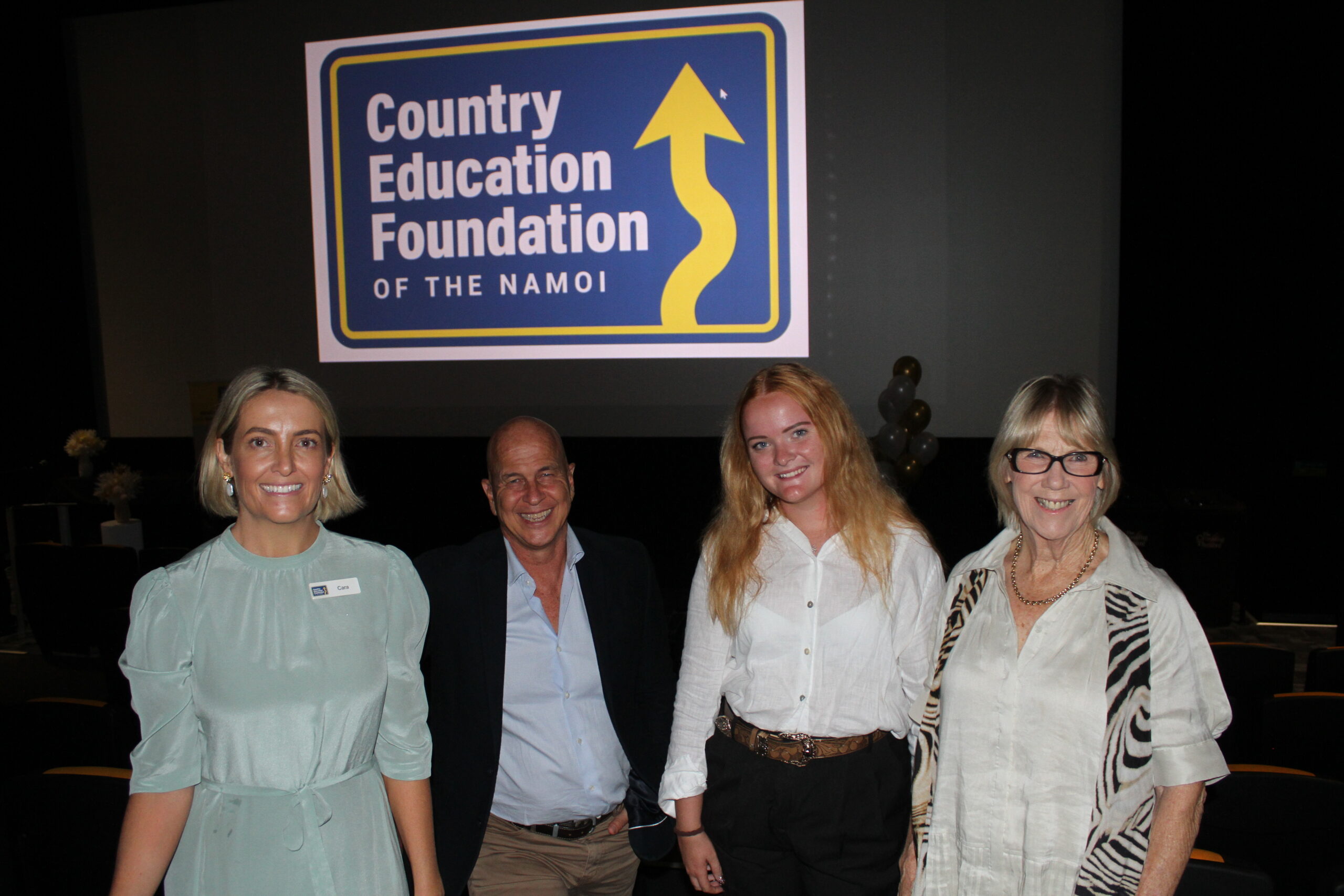
The harrowing experience of being imprisoned as a foreign correspondent in Egypt was recalled by former journalist Peter Greste at a Country Education Foundation of the Namoi fundraiser.
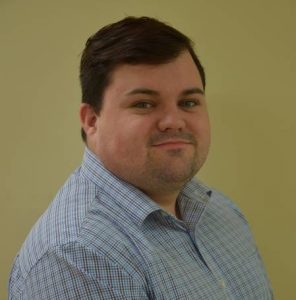
Mr Greste was the guest-of-honour at last Friday evening’s event at The Crossing Theatre and he vividly detailed his experiences in an Egyptian prison as well as the events that resulted in his arrest.
Working for the Qatar-based Al Jazeera, Mr Greste and two other journalists were arrested in Cairo in December 2013. He would be found guilty in June 2014, however, later deported to Australia in February 2015 after a sustained effort to see him released.


Attendees listened on as Mr Greste provided information about the Arab spring uprising in 2011 and the long-standing autocrat Hosni Mubarak being forced from power.
“There was an interim administration that was set up, and they held elections in the middle of the following year, the middle of 2012,” Mr Greste said.
“The first democratic elections in Egypt’s history. The Brotherhood won those elections. It was a little bit contentious.
“It was a product of the way that the electoral system had functioned. But what is indisputable was that those elections were the first free and fair elections the country had ever had. But one of the things I’ve learned as a journalist operating in a lot of post-revolutionary societies, successful revolutionary movements often make really crap governments, and so it was with The Brotherhood.”
Mr Greste said people out in the streets protested The Brotherhood and some of its draconian theological policies that they started to introduce.
“There was a lot of protest, and the military stepped up and said … ‘we’re a democracy now, you govern at the will of the people and you’ve clearly lost the confidence of the public. And so it’s time that you left. By the way, here’s a gun to your heads to make sure that you go’. In other words, it was a coup.
“But the military installed another interim government. And that’s the time that I arrived. At the end of 2013, when there was still rival protests between supporters of The Brotherhood, demanding that the government be reinstated, and supporters of the interim administration that wanted to see political change. It was a very, very volatile situation.”
Mr Greste described it as one of the most polarised societies that he’s been in that wasn’t already stuck in a civil war.
“Now, the thing is, as a journalist, when you cover stories, over time when you better get to know it, the more you get a sense of how far you can push things before you go into upset one side or the other. But I didn’t know Egypt well.
“I hadn’t been in the country before. I hadn’t operated there. And so, I was playing with a very straight bat.
“The government would announce some changes to the constitution, for example, I’d pick up the phone and call the opposition, the party that was last in power. Guess what? That was the Muslim Brotherhood. I get their reaction.
“Then I go to an analyst … to make sense of it all. It was vanilla journalism.”
Mr Greste said he knew at the time the government had started accusing The Brotherhood of being involved in acts of terror.
“But it turns out that by speaking to The Brotherhood, the government had started to think about us as being parts of a terrorist conspiracy,” he said.
“I didn’t know any of this. And on the night of December 28th … it was the 29th in Australia … I was getting ready to go out for dinner with a friend of mine, another BBC journalist who I knew from other assignments. And I remember I had the laptop open and I was streaming Triple J. I was dancing around the room, as you do. And there was a knock on the door. Now, it was unusual because if anybody wanted me, they usually used the telephone, whether it was my colleagues or the hotel staff.
“As I went to the door, and I didn’t think too much about it, but as I cracked open the door, I remember it was flooding inside as if there was a powerful spring behind it. And the room was filled with guys, very heavy set men, they weren’t wearing uniforms, but they moved with a kind of authority and discipline that suggested that these guys weren’t just a bunch of street thugs.
“This was something more serious, more official. And they pushed me to the back of the room, and they ransacked the place. They grabbed the notebooks, my cameras, my recording gear, they slammed the lid on the laptop and chucked it all into these bags, and they marched me down and placed me under arrest alongside one of my colleagues.”
Mr Greste would later discover they had made a third arrest, also one of his Al Jazeera colleagues.
“I’ve been detained before. It’s a bit of an occupational hazard when you’re a journalist working in some fairly dodgy parts of the world,” Mr Greste recalled.
“But usually what happens is that there are a couple of phone calls. Maybe spend an hour or two at the cells, perhaps overnight. But ultimately, you’re let go.
“At the worst, I thought … maybe I’m going to be taken to the airport and kicked out. And I thought that’s the way this would go as well.
“Until I went into the first cell that I got stuck in. It was about eight-foot square. In one corner there was a steel door, in another corner was a rather stinky squat toilet, and in another corner was a sink with a leaky tap in it. And that was it.
“There was no other furniture in this box. There was an exhaust fan high on the ceiling … and a light in the ceiling that was with a switch that was outside that you couldn’t control from inside the cell.
“The thing is that in this eight-foot square concrete box with no table, no chairs, no bed, no nothing. There were 16 guys. And some of them were quite literally going mad. They’ve been in that box for the dead part of six months.
“And I realised then that this was a bit more serious than what I’ve experienced in the past.”
After being taken to the National Intelligence Directorate, which is the Egyptian Secret Police, Mr Greste learned of the charges including aiding and abetting a terrorist organisation, being members of a terrorist organisation, financing terrorism, and broadcasting false news with the intent to undermine national security.
“When you think about it, you realise that those charges are about as serious as you could get short of actually pulling a pin on a grenade and chucking into a crowded room,” he said.
“The challenge for us was to try to figure out what on earth was going on. Why were we in prison? How could it be? That someone could look at the reality of the fairly bland, relatively boring journalism that we’ve been doing on the one hand and somehow come to the conclusion that we’ve been involved in some kind of terrorist conspiracy. What was going on here?
“We really did struggle with this. I was kept in a separate prison from my colleagues, but we came together on a couple of occasions for interrogation. And when we did, we had these furious arguments, like really serious arguments, because the way that we understood this was going to shape what happened to us in Egypt. How the case unfolded. And the thing is that our understanding, our interpretation of what was taking place would inform a strategy.
“Because this really was about our future. If we screwed it up, we were going to spend a very long time in prison.”
Mr Greste recalled the reasons they thought they had been imprisoned including misunderstanding of their work or getting information wrong, however, they had been confident their work was accurate.
They had also suspected regional politics could be at play, as they were working for the Qatari-owned Al Jazeera.
“One of the reasons I worked for them was because there was no editorial influence in the work that I was doing. I was absolutely confident in the integrity of our journalism,” Mr Greste told the gathering.
“The Egyptian government started accusing the Qataris of supporting The Brotherhood covertly, and because we worked for a Qatari government, perhaps they saw us as part of that conspiracy.”
Mr Greste recalled the court trial process as well as the day the guilty verdict was handed down including seven years’ imprisonment.
“That was a very, very difficult day. But it meant that I really had to rethink how I dealt with prison. The problem, the thing with prison is there’s a tendency for people to focus on the physical constraints, right? On the concrete and the steel that surrounds you, that’s locking you up,” he said.
“But let me take you back to that tiny cell that I was in when I first landed in prison. The thing I realised there was that for all of the physical challenges that presented, we actually had everything that we needed for survival. We had food, it wasn’t always great. It would keep you alive. And water, and shelter. The one thing that the Egyptian prison system is really good at providing is a solid roof over your head.
“The only thing that’s left, the thing that is really going to mess with you is your own head. Prison is a psychological problem. Those physical constraints exist because of the pressure that they had, the impact it has on your own psyche and your psychology.”
At last week’s CEFN fundraiser, Mr Greste also recalled the campaign to free him from prison, including the strong push locally as his brother Andrew and sister-in-law Kylie live in Wee Waa and are well-involved in the community.
Much of this support also played out in the pages of The Courier and Wee Waa News through news articles and letters to the editor.
Former proprietor of the newspapers, Wanda Dunnet OAM introduced Mr Greste to the gathering and personally recalled the community and newspapers’ push to have him freed from prison. Mrs Dunnet emphasised the need for freedom of speech and journalism.
“It is a cornerstone of democracy, and when censored is the first casualty of tyranny. Good, open journalism is vital, and it’s journalists like Peter who make a difference,” Mrs Dunnet said.
“Tonight is not just about hearing an extraordinary personal story, though it certainly is that.
“It’s also about reflecting on why journalism with integrity matters. And why it’s worth protecting and supporting.”
Mr Greste thanked his family and acknowledged the broader community.
“I really want to say a heartfelt thank you to this community, for the support that you gave me and my family. I wouldn’t be here without it,” he said.
To order photos from this page click here