


Life changed dramatically for a young Scottish lad when he emigrated to Australia in 1911.
He enlisted in the Australian Imperial Force in World War I, survived the conflict on Gallipoli and in the Middle Eastern desert, drew a soldier-settler block near Boggabri after the war and remained there for the rest of his long life.
John Roberts (Jock) Langlands grew up in the shadow of Glamis Castle in Scotland, where his father was a shepherd. The young Jock always claimed to have played with the Queen Mother when he was a child. Before leaving for Australia in 1911, he also worked as a shepherd.


In Australia, Jock Langlands went to the Walbundrie area, near Yass in southern New South Wales, where he worked until the outbreak of World War I. At the age of 24 he enlisted in the 1st Light Horse and was part of the ANZAC force on Gallipoli.

John Roberts (Jock) Langlands enlisted in the 1st Light Horse and was part of the Anzac force at Gallipoli.
As the troops were coming in to land under fire in longboats on ANZAC Cove, Scottie, as he was known to his soldier mates, grabbed a fellow soldier who was about to topple into the water. Many years later, he met up with the soldier at a service at the Boggabri Cenotaph. The soldier, Trooper Edgar Hollingworth, remained on Gallipoli through 1915 and was among the last 80 to leave the Peninsula in December.
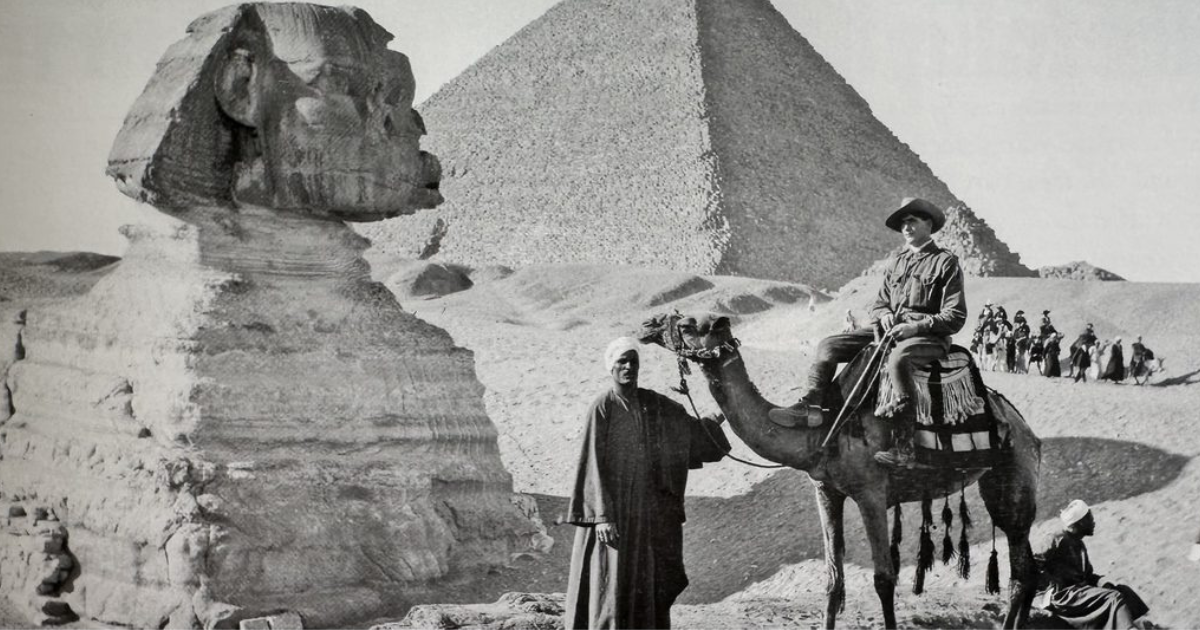
When the Australian forces withdrew from Gallipoli, Jock Langlands and his horse Darkie were sent to serve in the desert campaign in Egypt and Palestine. After the war ended, he was looking forward to visiting his family in Scotland but two weeks before he was due to sail to England, he contracted malaria and was sent back to Australia.
The Scottish soldier was a keen photographer and had a large box-bellows camera, which he used extensively during his service in Egypt and Palestine. The nitrate negatives remained in his possession for decades and were eventually sent by his family to the Australian War Memorial in Canberra and now form part of the memorial’s vast collection.
After his discharge on 23 June, 1919, Jock Langlands was employed as a chauffeur in Sydney by his Captain, John Burns, who was part of the international company of Australian merchants Burns, Philp and Company, which had its head- quarters in Sydney and offices in London, San Francisco and the South Pacific.
In 1921 Jock Langlands married a fellow Scot, Helen (Nell) Thompson Beedie, at Marrickville Presbyterian Church on 24 March. In the same year, he drew a soldier-settler block when the large Boggabri district property Wynella was broken up into 14 allotments.
Jock named his property Strathmore after the Scottish Earl of Strathmore. The couple raised four children on the farm – Nell, Ron, Cyril (Scottie) and the youngest Jack. The Scottish soldier remained on his “little piece of Australia” for the rest of his life. He died on Australia Day 1978, at the age of 87, leaving 58 descendants.
Extract from In The Line of Fire produced by Gunnedah & District Historical Society and edited by the late Ron McLean.
To order photos from this page click here