


Safe battery recycling
Batteries power many parts of our everyday life but not everyone knows what to do with them once they’re used.
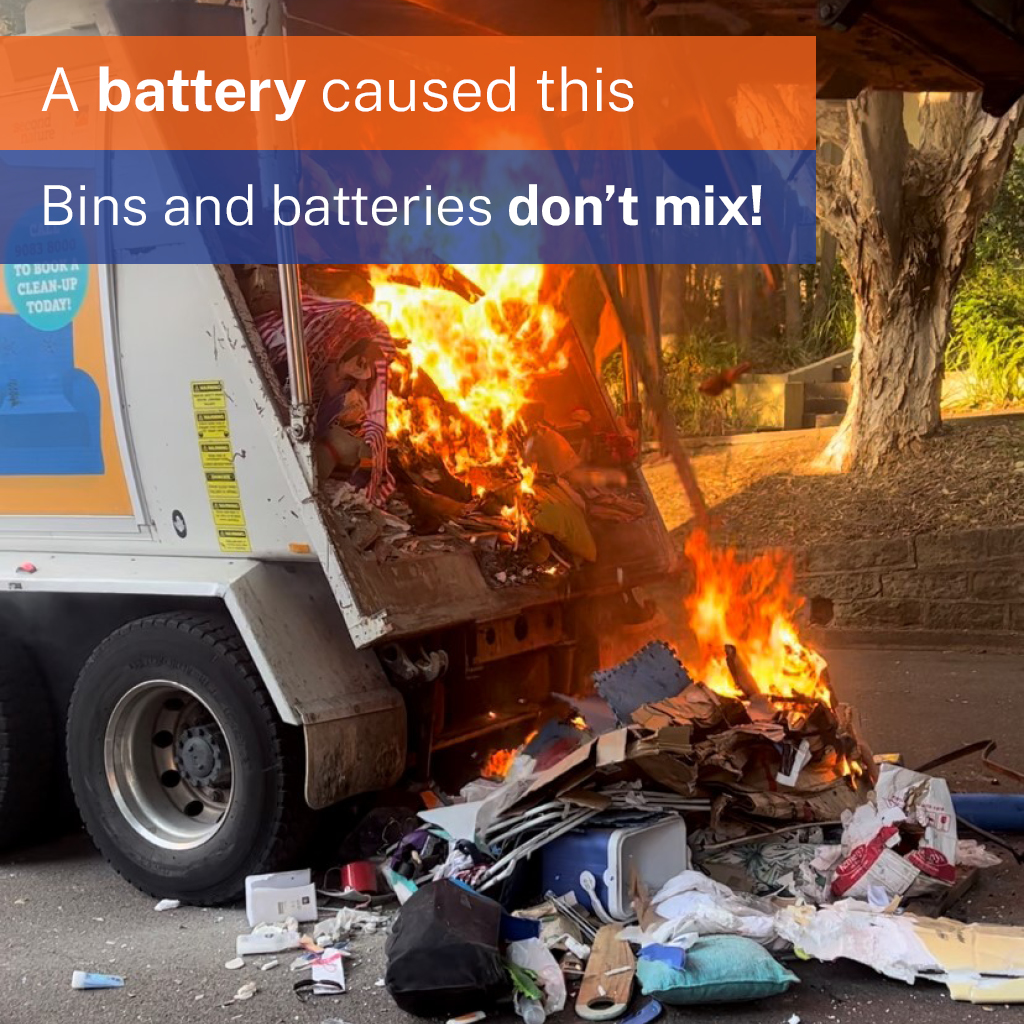
Batteries, or products containing batteries, cannot be disposed of in kerbside bins as they contain hazardous chemicals and can create a fire if the battery gets damaged, such as when compacted in a garbage truck.


Recycling locations
When disposed of correctly, 95 per cent of battery components can be recycled into new products. Here’s where you can recycle them:
– Community Recycling Centres
– Household Chemical CleanOut events
– Coles, Woolworths, Aldi, IGA and Bunnings
– The B-cycle search tool provides a comprehensive list of all drop off points in your area https://bcycle.com.au
– Find your nearest Community Recycling Centre (CRC) and identify what other items can be safely disposed of for free www.nirw.org.au/projects/community-recycling-centres
Batteries don’t belong in waste or recycling bins
Give batteries a safe goodbye. Take them to a collection site.
Batteries contain a range of metals including lead, mercury and lithium which can be hazardous to the environment when disposed of incorrectly.
They should never be thrown into household bins because they contain chemicals that contaminate our waste streams, pollute the environment and can cause catastrophic fires to council garbage trucks and waste facilities.
What to do with old batteries
When disposed of correctly, 95 per cent of battery components can be recycled into new products. Here’s what you can recycle and where.
· Small household batteries
You can drop off small household batteries at a Community Recycling Centre (CRC) for recycling. Accepted batteries include AA, AAA, C, D, 9V, 6V, button batteries and detachable/removable household device/appliance/power tool batteries.
Tape both ends of the battery terminal and drop them off for free at your nearest CRC www.nirw.org.au/projects/community-recycling-centres
Alternatively drop them off at Coles, Woolworths, Aldi, IGA or Bunnings.
· Batteries over 5kg
Some larger batteries, for example, batteries from electric bikes and scooters, and car batteries, can be dropped off at a Community Recycling Centre or Household Chemical CleanOut event. Solar panels and large energy storage batteries are not accepted.
Lithium-ion batteries
Lithium-ion batteries are often contained in phones, tablets, power banks, computers, toys, appliances and tools, as well as mobility equipment such as electric bikes and scooters.
Lithium-ion batteries can be cylindrical, flat, rectangular, pouch, and device specific. If the battery is rechargeable and has “Li” or “Lithium” printed on it, you can safely assume that it is a lithium-ion battery.
When lithium-ion batteries are damaged they can produce violent bursting of battery cells, hissing and release of toxic, flammable and explosive gases, and an intense, self-sustaining fire that can be difficult to extinguish.
If you can safely remove the lithium battery from the product by hand, tape the terminals using a non-conductive tape like clear sticky tape.
Taped handheld lithium batteries can be returned to Community Recycling Centres, Household Chemical Clean Out events, Coles, Woolworths, Aldi, IGA and Bunnings
If the battery cannot be easily removed by hand or is embedded into a product, please do not attempt to remove it. Instead, leave it as is and recycle it at the Tamworth Community Recycling Centre embedded batteries trial location.
For more information visit https://www.epa.nsw.gov.au/Your-environment/Recycling-and-reuse/household-recycling-overview/Safe-battery-recycling
To order photos from this page click here